Friday, November 29, 2019

THE SET-UP (1949)

RKO Radio Pictures, 72m 34s


In his recent explanation of why boxing is so different from most other forms of athletic competition, boxing analyst Max Kellerman described the sport as a contest of wills. A bout's outcome is determined not just by the pugilistic capabilities of the participants, but by each fighter's respective will to endure whatever punishment his opponent can deliver. Sometimes an unspectacular but durable fighter with a big heart can outlast the opposition's superior firepower. That possibility makes professional prizefighting exceptionally dangerous activity for the participants, as well as dramatic viewing material.  Everybody likes to root for a likable underdog who just won't quit when faced with serious adversity. Bill “Stoker" Thompson (Robert Ryan) is that battle-scarred fellow in director Robert Wise's THE SET-UP, a vigorous film noir that approximates real time.

The story commences with a timekeeper sounding the bell at ringside. As the narrative progresses we hear the ticking of a hotel room clock, see the hands of the town street clock and witness close-ups of the timekeeper’s clock at ringside between rounds. The uncompromising reality of time stands as the film's most crucial theme, emphasized by the recurrent images of clocks throughout the narrative as well as the stoic persistence of the lead protagonist, a journeyman heavyweight who now pensively recalls his first prizefight took place twenty years ago in Trenton, New Jersey. That is a long spell to ponder for any professional athlete, especially one trying to eke out a living in the fight game. A boxer whose time has passed and thus has become his own worst enemy makes for impactful film noir material, particularly in this case. The 35-year-old Thompson is among the most sympathetic of noir characters, punished severely and unfairly for giving his best effort in a sport that is notoriously brutal.


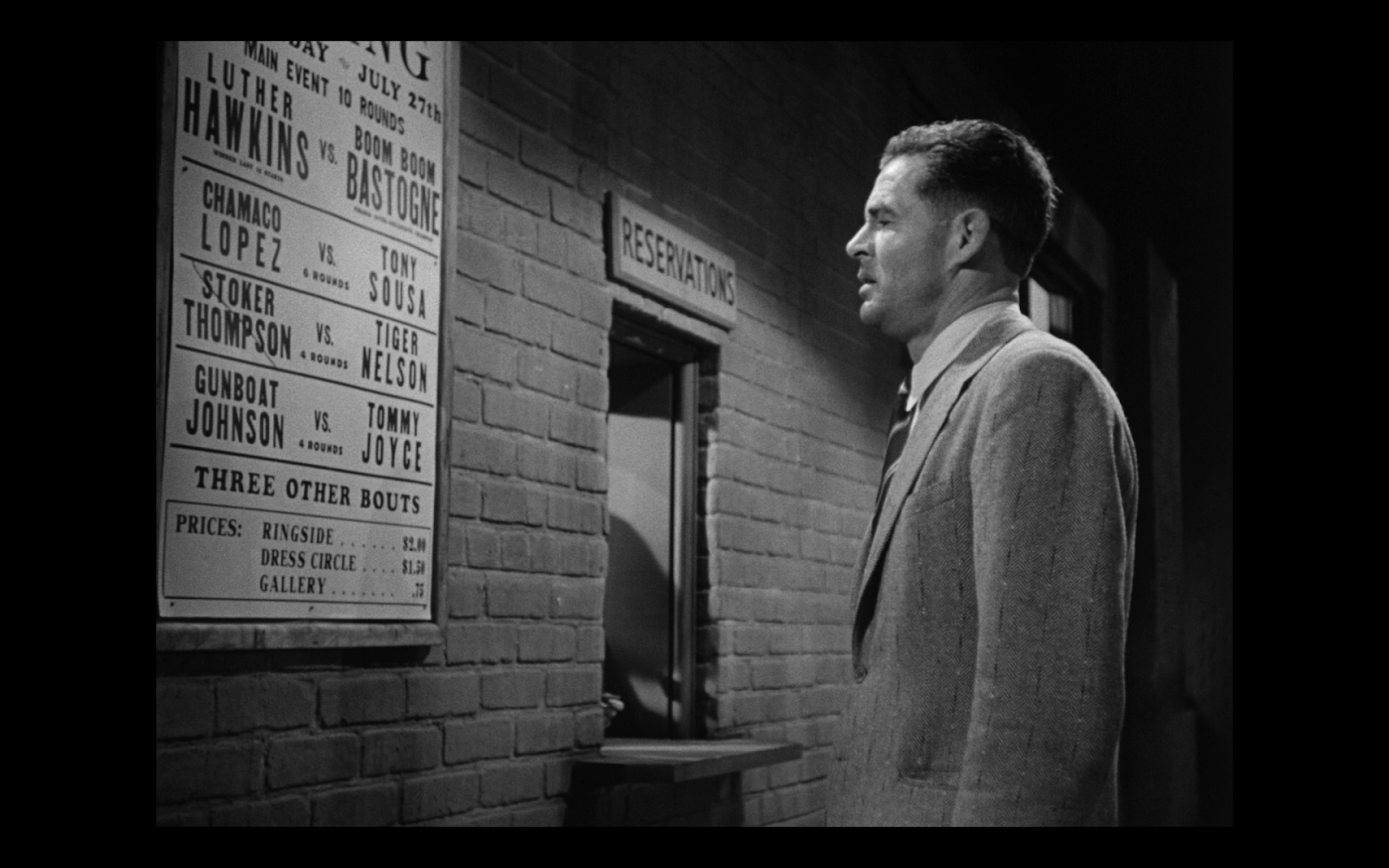
In what must feel like the supreme insult to a boxer's ego, Thompson's upcoming fight is to take place after the evening's featured event. The opponent in front of him is Tiger Nelson (Hal Baylor, here credited as Hal Fieberling), who is a mere 23 years of age. Despite the enormous age gap that separates Nelson from Thompson, money is exchanged to ensure Thompson hits the deck and stays there. In one of film noir’s most cynical gestures, Thompson's cigar-chomping manager Tiny (George Tobias) is so certain his fighter hasn't a prayer he never informs him his fight’s outcome has been predetermined! Even before that revelation, we sense Tiny does not have his fighter's best interests in mind. The moment we meet the presumably second-rate manager, he dismissively strikes a match across Thompson's name on the arena's poster, leaving a noticeable scratch over the name of the man he supposedly represents. Thompson's trainer Red (Percy Helton) is understandably skittish about the whole set-up, but he keeps quiet. With an internal support structure like that, one would hope the veteran boxer's fan base would be more enthusiastic about his next contest, but spectators are not very kind in their remarks about him, for instance:

"I remember him when I was a kid!"
"Where's your wheelchair?"
"He's an old man!"

In spite of the less than encouraging court of public opinion, Thompson stubbornly clings to the notion that he has the tools to end matters with one mighty punch. But when Gunboat Johnson (David Clarke) is dragged back to the locker room after a demoralizing defeat, the other fighters look on in knowing recognition:  someday this happens to every fighter who competes long enough. That sequence speaks to the true crux of prizefighting, which is unlikely ever to change. How does any practitioner of the sweet science call it quits when he knows he can still punch with power? It has been said for the fighter blessed with punching power that the power is the last thing to go. And when he does retire, one way or the other, to what exactly does he retire? What significant job opportunities exist for ex-prizefighters, especially those who were known to have hung around the ring past their prime? Any sentient observer might conclude there is no obvious exit strategy for the shot fighter. Those questions linger as Thompson soldiers on in boxing's no man's land, forever “one punch away” from a revitalized prizefighting career. In the meantime, he absorbs more punishment. “You’ll always be just one punch away,” declares his wife Julie (Audrey Totter, one of the few actresses I would describe as a possessor of rugged good looks). Though THE SET-UP’s runtime mostly respects actual time, the element of time is manipulated during Thompson’s climactic fight to make the brutality inside the ring even more excruciating. Round 1 clocks in at 3:17, round 2 at 3:37 and round 3 at 4:02!


The film noir of the late 1940s often doubles as a classroom session devoted to the dangerous tensions inside capitalism's underbelly, an overstuffed area bloated with class separation, cutthroat competition and unrealized dreams. The unglamorous urban setting of THE SET-UP percolates with dance halls, liquor stores, competitive newspaper salesmen, ungenerous gambling machines, street pitchmen and a wide variety of people chasing odds. It is an environment in which there are few obvious winners and a lot of average people just trying to get by on a daily basis. "Everybody makes a book on something," Thompson observes. Of primary interest in this noir city are the disturbingly bloodthirsty fight fans, who demand the most violent possible outcome to each match. The diversity of the fan base is given emphasis; one of the ticket holders is a blind man who does not allow his lack of sight to keep him far from the carnage. The montage of humanity captured inside the arena defines the term “urban jungle” better than any assortment of words ever could.


Fittingly, the major plot mechanics are empowered by the underworld business maneuvers of local gangster Little Boy (Alan Baxter), who has a significant investment in a Thompson loss. After Thompson fails to cooperate, the filmmakers make great use of the venue, both from visual and audio perspectives. Presumably the last boxing arena Thompson will navigate through is an empty one; his fighting career symbolically finished. The suddenly on-the-run Thompson attempts to avoid the representatives of the man who hemorrhaged money on Nelson's surprising defeat. As Thompson scurries around the arena in one of film noir's best "nowhere to run" concluding sequences, every sound echoes throughout the place. We recognize his time is up. On an optimistic note for an otherwise pessimistic narrative, THE SET-UP concludes with Thompson free to pursue a new life with Julie. After the moral and physical triumph in the ring, Thompson departs the sport of boxing horribly damaged, but with his life, and the potential for some sort of humble fresh start. Julie tells him “We both won tonight.” Only in a film noir could such a finish be described as an outright victory for the cinematic couple.

THE SET-UP was the first feature film screenplay credited to Art Cohn, who later co-wrote TOMORROW IS ANOTHER DAY (1951), one of the great couple-on-the-run noir titles. Cohn adapted Joseph Moncure March's long narrative poem THE SET-UP (1928), the story of a past-his-prime black boxer just freed from incarceration. Obviously the racial aspect of the poem was lost in the filmed version when a white actor was cast as the main protagonist. Nonetheless, Robert Ryan really registers as “Stoker" Thompson, one of film noir's most convincing everyman types. Still in admirable physical condition at the time of filming, Ryan was an intercollegiate heavyweight boxing champion while a student at Dartmouth College. Prolific cinematographer Milton R. Krasner worked on two other film noirs in 1949:  William Dieterle's THE ACCUSED for Paramount Pictures and Joseph L. Mankiewicz's HOUSE OF STRANGERS for Twentieth Century Fox.


A single-layered Blu-ray edition of THE SET-UP has been made available through Warner Archive, and the 1080p presentation honors their laudable standards. Based upon well-preserved 35mm source material, this welcome upgrade makes for intense viewing framed at the original theatrical aspect ratio of 1.37:1 with DTS-HD Master Audio 2.0 Mono. For noir collectors, this is an obvious must-own.

Warner Blu-ray

Warner DVD

Supplemental material is limited to an audio commentary track with Robert Wise and Martin Scorsese, ported from Warner's 2004 DVD release. Wise reveals his belief in test screenings, which allow filmmakers to repair segments that prompt unexpected audience reactions. Scorsese, who graced us with the great Jake LaMotta biopic RAGING BULL (1980), does most of the talking as he relates his obvious passion for the career of Wise. Routinely jumping from one genre to another was never an easy task, Wise just made it look easy. Scorsese applauds some of Wise's previous achievements as a director, including producer Val Lewton's noirish horror productions at RKO THE CURSE OF THE CAT PEOPLE (1944) and THE BODY SNATCHER (1945). Later at RKO Wise helmed BORN TO KILL (1947), one of the great tough-guy noirs with a memorable lead thug portrayed by Lawrence Tierney. Also mentioned are ODDS AGAINST TOMORROW (1959), one of the great noir stragglers, and the Rocky Graziano biopic SOMEBODY UP THERE LIKES ME (1956), Wise's return to the boxing film. Naturally the majority of Scorsese's focus is on THE SET-UP, which Wise recalls as his favorite film he made for RKO. From a technical standpoint, Scorsese proves himself to be an especially helpful guide. He believes it was Wise's experience as a film editor that allowed him to emerge as a master of the film medium. Wise understood when to hold the image versus when to cut. To understand the difference between the two, one must have great respect for the visual image. From an analytical perspective, Scorsese sees the boxing ring as an allegory of human life, our daily struggles encapsulated in the squared circle. He views the Penny Arcade & Fun Palace similarly, where the noir force of fate is well dramatized by the stingy crane machine that fails to pay off just when it looks like it will. In this noir city, perhaps everyone is a bit like Thompson, limping toward the end of the road, but still hopeful a big payday is out there somewhere, just “one punch away.”


Saturday, October 19, 2019

WHIRLPOOL (1949)

Twentieth Century Fox, 97m 17s


Gene Tierney's elegant visage takes on an aura of sadness in this outing, to great cumulative effect. Her psychologically troubled character is one of many featured noir protagonists to be tormented by the past, even if one restricts comparable productions to the common year of 1949. The long-term effect of the past maintains a tight grip on characters in CRISS CROSS, THE CROOKED WAY, IMPACT, THE RECKLESS MOMENT, SIDE STREET, THE THREAT and TRAPPED. But old traumas are just part of the story in WHIRLPOOL, a film very much concerned with how men think of females, from childhood through adulthood, and how patriarchal dominance might impact a woman's hesitance to trust men. At stake is the potential destruction of a moral woman in an immoral world. This feature is among the most progressive of noirs and one of the most compelling to be produced and directed by Otto Preminger, who was well versed in the genre.

For the uninitiated, the story opens in The Wilshire Store in Los Angeles, California, where a store detective (Ian MacDonald) busts socialite Ann Sutton (Tierney) for pocketing a pricey pin. The gotcha moment causes Ann to pass out, conveniently perhaps. When she regains consciousness she faces the wrath of store personnel, but is aided by David Korvo (portrayed with tenacity by José Ferrer), who smoothly gets Ann out of harm's way. The following afternoon he gains her trust, though not nearly to the extent he would prefer. Self-described as both astrologer and hypnotist, David takes her to a party given by Tina Cosgrove (Constance Collier), where he demonstrates an uncanny ability to read others with his eyes. Ann proves herself susceptible to David's hypnotic suggestions, but again she resists his best romantic impulses. While at the party Ann encounters his ex, Theresa Randolph (Barbara O'Neil), who cautions Ann that David is driven only by money. Ann does not want to hear it, and becomes noticeably upset with Theresa, who later is found strangled with Ann's scarf. Naturally Ann is the prime suspect.


WHIRLPOOL shares a kinship with other "woman in peril" noir permutations of the late 1940s and early 1950s, including POSSESSED (1947), THE RECKLESS MOMENT (1949), THE KILLER THAT STALKED NEW YORK (1950) and SUDDEN FEAR (1952). With their textured female protagonists and dark narratives that envelop them, these titles prove the main character of the film noir need not be male. Ann Sutton is another of noir's complex female leads, both strong and vulnerable. Though introduced as an impulsive shoplifter, Ann possesses a bank account large enough to write an unexpected check for $5,000 with little hesitation. She needs to steal accessories like a shark needs sharper teeth. Eventually she reveals that as a young woman she stole to get back at her father, who always thought of his daughter as a child. That is to say her fragile disorder is explained in psychoanalytic terms, ironically hidden from her husband Dr. William "Bill" Sutton, M.D. (Richard Conte), a man with extensive training in psychoanalytic theory.

For years Ann has feigned contentedness in her role as the supportive wife of a highly-regarded doctor. In truth she remains tormented by her childhood. Her turbulent situation as an adult remains much as it was in her past; the only difference now is she steals out of marital frustration. In some ways, her husband treats her as a child, as her father always did. Despite unresolved issues with her upbringing, Ann's sturdy moral character remains as the married woman repeatedly resists the spirited advances of David. He hypnotizes her at Tina's, but even while she is under hypnosis he cannot coerce her hand into his, much to his consternation. In a later scene, David unsuccessfully attempts to meet with her in his hotel room. He becomes noticeably petulant after she sticks to her well-grounded morals. Though many of the best realized sequences highlight the dynamic between Ann and David, the most critical conflict in WHIRLPOOL stands between Ann and Bill. After eight years of marriage, Bill loses trust in his wife, who is devastated to realize her husband does not believe in her innocence and loyalty.

In a nod to the patriarchal culture the movie reflects, Ann's existence is defined more by what men think of her than anything that is within her reasonable control. After having been raised by a father she claims never loved her, Ann attempted to escape to Bill, a reputable psychoanalyst dedicated to the health and wellbeing of his patients. That he is a professional to be taken seriously is suggested by his title affixed to his home's front door. Interestingly, that same door implies a barrier that separates him from his wife when she needs him most. The emotional and intellectual distance between Bill and Ann is emphasized further when Ann expresses an interest in Bill's practice. His reply is telling, "Just stay as you are, as you've always been, healthy and adorable." What strange words to be spoken from a husband to a wife; those might be the thoughts a father thinks but never articulates to his daughter, that impossible hope his child never matures. Later Bill again contextualizes his partner in terms of her physicality when he mentions he likes to see her noticed by others who must recognize, like it or not, she is with him. Clearly the doctor is interested more in an ornamental wife than one who may be his equal on a more meaningful level. The continuation of his marriage depends upon his ability to get his wife to openly discuss her history, as well as her present. Early in the film Bill hints at this need when he discusses a patient who cannot open up to him. At that point in the narrative, he has no idea his wife finds herself in roughly the same circumstances as his patient, at war with herself and the conditions that feed her descent into kleptomania. That husband-wife scene introduces one of the film's major themes:  it is unhealthy to bottle-up feelings, "...locked away in the characterization of a serene and devoted wife," as Ann later describes her sense of alienation. Her marriage parallels her childhood and best explains the film's title treatment. The story is all the more moving considering the well-chronicled mental health issues that plagued the actress Tierney for much of her adult life.


The charlatan David contrasts obviously with the good doctor Bill Sutton, especially in terms of the selfless professionalism we all hope to encounter when in need of care. Though the story's homme fatale David works out of his place of residence, which draws a correlation to Bill, otherwise the two men have little in common. Bill is a distinguished man of principles, David is a shady opportunist, a scoundrel with no altruistic tendencies and no medical diploma. Despite his many less than admirable attributes, David is a man who possesses startling powers over others, including himself when necessary. He shows smooth-talking confidence when he gets Mr. Simms (Larry Keating) to back off from Ann for stealing from his shop. Like Ann, the viewer cannot help but be impressed, even as one may wonder about David's ulterior motive. At lunch with Ann, he states that a healthy marriage has its basis in deception. As he commends her for keeping her shoplifting attempt from her husband, he theorizes, "A successful marriage is usually based on what a husband and wife don't know about each other." Eventually the narrative completely buries this notion, but not before confirming at least some of what David brings to the table regarding Ann. There is no doubt David is a man without honor, but he is spot-on in his diagnosis of Ann, whose unhappiness he detects. In another of the film's several ironies, David is correct in his (admittedly self-serving) theory that Bill is at fault for his wife's disconnect from her supposedly privileged world. Had that not been the case, there would have been no opportunity for David to inject himself into Ann's life. David's unique qualities are on display best at Tina's party, where he labels Feruccio di Ravallo (Fortunio Bonanova) as a manic-depressive, complete with fresh scars on his wrist! Though David later mentions to Ann he had information on Feruccio prior to meeting him, that initial exchange between David and Feruccio ("The Baron") stands as one of the oddest and darkest of noir revelations. David exposes Feruccio's suicide attempt in a party setting, and Feruccio shows only admiration for what most probably would find profoundly humiliating. It is difficult to imagine that scene as plausible in the context of any other genre movie, but hammered into the noir narrative, the on-the-spot evaluation does not strain credibility.

Master filmmaker Otto Preminger reunited with his LAURA (1944) star Gene Tierney and that film's composer David Raksin. Other commonalities between the two productions abound. For instance, an arrangement of masks displayed above David's bed closely recalls the home of Waldo Lydecker (Clifton Webb), the hoity-toity columnist from LAURA. Preminger associates mask collections with deceptive characters. In another homage to LAURA, consider the large portrait of Theresa Randolph above her fireplace, an image linked to a murder riddled with complexities. In more general film noir terms, WHIRLPOOL can claim one of noir's best bad guys in David Korvo, whose carefully constructed plans do not mesh with his expiration date. One of the film's social concerns is the traditional family in jeopardy, a particularly potent theme of the post-WWII noir era. The Suttons look happy on the surface, but risk being destroyed from within. It could be argued the noir force of fate entangles Ann with David, though the spark for his appearance is her lack of fulfillment as a trophy wife. That trait makes her predisposed to his skill set (real-life hypnotist Fred Schneider was brought in as a technical consultant for the hypnosis sequences). The compromised film noir family is defined further by the character Lieutenant James Colton (the always credible Charles Bickford), the cop who wants to bring charges against Ann for the murder of Theresa. Colton's beloved wife died on the operating table due to a botched surgical procedure. The identical procedure protects the cynical mentalist David, whose recovery from gallbladder surgery at the time of Theresa's death ostensibly places him in the clear for her murder. The truth behind his whereabouts energizes the film's distinguished final act, when David unknowingly accelerates his deserved decline. The moribund David embodies one of the genre's "walking dead," similar to those depicted in DETOUR (1945), DECOY (1946), ACT OF VIOLENCE (1948), D.O.A. (1950) and the Billy Wilder masterpiece ACE IN THE HOLE (1951).

The idealized portrait...

...a film noir hallmark

Ben Hecht and Andrew Solt combined on the screenplay, an adaptation of the Guy Endore novel METHINKS THE LADY... (1946). I cannot say enough good things about Hecht, whose many screenwriting credits include essential film noir properties such as KISS OF DEATH (1947), RIDE THE PINK HORSE (1947) and the stellar WHERE THE SIDEWALK ENDS (1950), Preminger's follow-up to WHIRLPOOL, with Tierney again cast as his female lead. Solt's next credit was even more impressive:  director Nicholas Ray's IN A LONELY PLACE (1950), one of the most consummate of all film noirs and certainly one of the most downbeat. Director of photography Arthur C. Miller is credited with the cinematography of close to 150 productions, his final effort being director Joseph Losey's THE PROWLER (1951), a personal noir favorite of mine.

New to domestic Blu-ray as of last month, this region-free Twilight Time disc produces a richly defined presentation of one of my preferred noirs of the late '40s. The level of film grain adds to the authenticity of the presentation, well accounted for in this review's screen captures. Since this is the usual 3,000-unit Twilight Time build, it is recommended the noir collector press the ‘buy’ button while the disc is readily available. Framing is at 1.33:1, audio options include English 2.0 DTS-HD MA and English 1.0 DTS-HD MA.

Twilight Time Blu-ray

Fox DVD

The audio commentary track with film historian Richard Schickel was extracted from the "Fox Film Noir" DVD issued in 2005. As was the case with his track for GILDA (1946), Schickel's commentary is intermittent rather than steady, but his observations are solid. He identifies WHIRLPOOL as typical Preminger material:  someone with a compromised past descends into an obsessive criminal plot. Schickel helpfully observes that Preminger shied away from excessive editing. The filmmaker preferred to let the mise en scène do the talking, a practice that lent a strong sense of objectivity to his work. Another good observation is that despite his well-documented reputation as a tyrant on the set, Preminger nonetheless boasted a healthy stable of recurring collaborators. Schickel admires the film under review, but not to the point he is unable to discuss some of its plot concessions and improbabilities. He also credits screenwriter Hecht as one of the important forces behind the adoption of psychoanalytic themes in film, i.e. the Alfred Hitchcock titles SPELLBOUND (1945) and NOTORIOUS (1946).

Other bonus material includes the isolated music track and original theatrical trailer (2m 39s), also with isolated music track. The usual Twilight Time catalogue is a menu option, and a booklet essay by Mike Finnegan is part of the packaging.


Monday, September 9, 2019

KISS ME DEADLY (1955)


NOIR CITY: CHICAGO 2019
Music Box Theatre, Chicago, IL
Friday, September 6th, 2019 to Thursday, September 12th, 2019

KISS ME DEADLY (1955)
United Artists, 106m
*Presented as it was released in 1955; in 35mm courtesy of Park Circus


"Remember me when I am gone away,
Gone far away into the silent land;
When you can no more hold me by the hand,
  Nor I half turn to go yet turning stay.
Remember me when no more day by day
  You tell me of our future that you planned:
Only remember me; you understand
  It will be late to counsel then or pray.
Yet if you should forget me for a while
  And afterwards remember, do not grieve:
For if the darkness and corruption leave
  A vestige of the thoughts that once I had,
Better by far you should forget and smile
  Than that you should remember and be sad."

—"Remember," Christina Georgina Rossetti (December 5, 1830 — December 29, 1894)

KISS ME DEADLY may be the finest of film noirs released in the 1950s, but author Mickey Spillane was not impressed with what screenwriter A.I. Bezzerides did to his novel. According to event host Eddie Muller, founder and president of the Film Noir Foundation, Spillane said all that remained of his sixth novel to feature private investigator Mike Hammer was the title. The leftist writer Bezzerides obviously did not think much of Spillane's signature character, and went the extra mile to make sure he could not be construed as the hero of the filmed adaptation. Whether one likes the onscreen Hammer figure or not, there is much to admire about the film world he inhabits. Despite adherence to the usual dictates of film noirKISS ME DEADLY does not look or sound quite like any other noir film. In comparison with other examples of '50s noir, it seems oddly contemporary; its main difference from the modern crime story is the absence of ubiquitous f-bombs. The nihilistic production also benefits from unrelenting toughness, Ralph Meeker's exceptional performance as a marginally likable heel and some quirky female characters that seem plucked from the David Lynch universe.

Director Robert Aldrich (WHAT EVER HAPPENED TO BABY JANE? [1962]) makes the most of an intense introductory sequence that begins with Christina Bailey (Cloris Leachman) running barefoot down a dark highway. When Mike Hammer (Ralph Meeker) narrowly avoids plowing into her, he shows concern only for the preservation of his smooth ride. "You almost wrecked my car," he grumbles in disgust. The tone is set. Next the opening credits scroll backwards over the orgasmic panting of Christina, now attached to Mike in his convertible. She is a fugitive from a psychiatric ward, and soon enough those seeking her make their presence known. In an unforgettably suggestive segment, Christina is tortured with pliers(!) by men who remain anonymous to the camera, while a groggy Mike is helpless to intercede. The apparent leader of the villains calmly speaks with disturbing eloquence after Christina becomes non-responsive. The unlikely noir couple is left for dead, but Mike survives and finds himself absorbed in a mystery he may be ill-equipped to comprehend. Ironically for a good chunk of the film he is perplexed by a clue that reads "REMEMBER ME." That request is a tall order for a self-absorbed man like Mike, who parasitically feeds on divorce cases for his source of income.


The death of Christina draws the attention of the Interstate Crime Commission, and Mike is curious as to why. The cops show complete disdain for Mike, whose detective practice involves capturing evidence of married people breaking their vows. Worse than that, he and his assistant Velda Wickman (Maxine Cooper) get personally involved with the couples they target in the interest of gathering damning information. Mike already had proven in the opening sequence his instinct is to not cooperate with law enforcement officials, so it comes as no surprise when he refuses to play ball and leaves the interrogation room. One man contemptuously comments, "Open a window." These men seem no better than Mike. Lieutenant Pat Murphy (Wesley Addy) in particular is one smug little bastard, absolutely impossible to like. Pat personally informs Mike that his PI license and handgun permit have been revoked. Film noir sometimes highlights the determination of effective public servants in examples such as T-MEN (1947), TRAPPED (1949), APPOINTMENT WITH DANGER (1950) and PANIC IN THE STREETS (1950), but KISS ME DEADLY finds little faith in public officials. Who are the true villains here?

As Mike stubbornly persists in sticking his nose in where he knows it is most unwelcome, it becomes evident he is an outsider in every way imaginable. He associates best with other outsiders and worst with those who feign respectability. His probable best friend is Nick (Nick Dennis), a fast-talking, affable Greek auto mechanic. Mike is also helpful to an Italian American burdened with what appears to be a very heavy storage chest. When Mike gets loaded in a nightclub, he is the only white face among the black clientele; he has more in common with people of color than other white people. A man easily angered, Mike gets impatient with those who do not cooperate. He delights in pushing people around, and he can take a punch as well as anybody. Sometimes when he gets tough it is easy enough to side with him, as when he is first confronted by Charlie Max (Jack Elam) and Sugar Smallhouse (Jack Lambert). Other times Mike makes it difficult to gain the viewer's allegiance. The deeper he gets into his investigation, the more crude slaps he dishes out, as when he roughs up a meek front desk clerk. The PI is especially mean-spirited when he breaks an opera fanatic's classic record, even more so when he crushes the fingers of Doc Kennedy (Percy Helton) in a desk drawer. In those two instances of highly questionable procedure, the camera captures Mike's admiration for the type of work he enjoys all too well. The film noir often uses narration to smooth over a lead protagonist's rough edges to encourage the viewer to identify with that individual. The absence of narration in KISS ME DEADLY marks a genre in transition, as well as a main character we are not meant to admire. Even if the viewer should not condone Mike's tactics, it is difficult not to empathize a little after the brutal killing of his friend causes the gumshoe to go berserk.


Though critics and fans often brand Mike a stupid individual, I think he is better described as a boorish, egocentric character who is out of his element, a type of man whose time has passed. He is intelligent enough and experienced enough to know a big case when he stumbles onto one, and he proves his street smarts on numerous occasions, especially when he correctly deduces what became of a small artifact associated with Christina. He also predicts the location of two incendiary devices placed within the automobile he was gifted by those who would celebrate his violent demise. In a wonderfully intense conversation, Carl Evello (Paul Stewart) admits his organization has underestimated Mike repeatedly. Mike's instincts prove less reliable when he encounters a package equipped with far superior firepower compared with what was found in his newest car. The air of fatalism that chokes film noir characters comes neatly packaged, but dangerous to the touch. Mike's first exposure to "the great whatsit" as Velda describes it creates a painful brand on his wrist (we know it is serious when the proven tough guy Mike winces!). That event marks Mike for death.

"If you had not stopped to pick up Christina, not any of these things would have happened..."

KISS ME DEADLY features about the oddest assortment of revisionist femme fatales ever to grace a noir film. Christina latches onto Mike in the opening sequence, despite his immediate disdain for her highway obstacle act. Would he have invited her into his car had he not imagined her naked under that trench coat? Probably not. Interestingly, only after Christina pokes Mike about his self-centered masculinity does he begin to loosen up a little in front of her. But in most prime examples of noteworthy noir themes, Mike would have been the wiser to allow Christina to fend for herself (she may have been better off as well). His chance involvement with Christina leads to a deadly connection with the mysteriously mousy Lily/Gabrielle (Gaby Rodgers) that has consequences far greater than anything Mike may have considered. And though her screen time is brief, Friday (Marian Carr) strikes a chord as perhaps the most weirdly amorous dame to appear in a noir film. In another example of his better judgment, Mike shows some restraint when confronted with her aggressive advances.

Point that thing somewhere else

The "good" girl has her share of baggage, too. Velda is always hot for Mike, and she certainly is an attractive brunette, but the sadomasochistic Mike would prefer to pimp her out in service of his trashy detective enterprise. She puts it well in the hospital sequence in the first act when she tells him, "You never need me when I'm around." The hotter she gets, the cooler he treats her, and his head usually turns when another skirt walks by. That is not to suggest he harbors no attraction to Velda, but her ability to seduce any other man means more to him than whatever feelings he holds for her. During the opening scenes, Christina correctly identifies Mike as a man who cares only about himself, a man who cannot give, only take. Ultimately that quality condemns him. In light of the film's devastating concluding sequence, Mike (and many others) would have been grateful had he granted Velda the alone time she always desired and steered clear of crazed blondes. But upon repeat viewings of the film, Velda's neediness is a little pathetic. She wants Mike more than any man would wish to be wanted.

The fine screenplay is complemented by cinematographer Ernest Laszlo (IMPACT [1949], D.O.A. [1949]), who relies heavily on the use of oblique camera angles, particularly in the early going. A nice touch I noticed for the first time at this event's screening is the emphasis given to the hydraulic floor jack used to quickly service Mike's vehicle after he picks up Christina—one of those devices has a role in a gruesome murder later in the story. Laszlo's coverage of complex stairways, both interior and exterior, stands for the complicated and hazardous noir labyrinth through which Mike travels. Many of the interior staircases are ornamentally fabricated; most exterior staircases are unusually high and would make for an exceptionally painful way to take a tumble (as a thug tailing Mike learns). That stairway fall always makes me gasp—somebody did that stunt! According to Eddie Muller, that scene utilized an actual staircase with no special padding.


The conclusion of the film intended by director Robert Aldrich was not reinstated until 1997. The truncated ending in which nobody escapes the beach house may have been less open to interpretation, but neither version suggests a different end result for the lead protagonist, who forfeits his future when he opens the modern equivalent of Pandora's box. In any case, I do not think Mike should shoulder the blame for the catastrophic event that ends the film. All the blame should go to Dr. G. E. Soberin (Albert Dekker), who fails to take his own advice. Soberin has a lot to say about the huge mistake Mike made when he got tangled up with Christina, but in the film's final sequence Soberin makes a far greater error when he treats Gabrielle like a child; the intellectual is somehow completely oblivious to her potential danger. As the doctor's name implies, KISS ME DEADLY's ultimate takeaway is sobering indeed.


Saturday, September 7, 2019

TRAPPED (1949)


NOIR CITY: CHICAGO 2019
Music Box Theatre, Chicago, IL
Friday, September 6th, 2019 to Thursday, September 12th, 2019
NOIR CITY: CHICAGO 2019 SCHEDULE

TRAPPED (1949)
Eagle-Lion Films, 78m
*Newly restored 35mm print


This year's NOIR CITY: CHICAGO lineup celebrates "Film Noir in the 1950s" but includes a straggler from 1949, presented this afternoon by Eddie Muller, the host of TCM's Noir Alley. Thanks to a 35mm print that emerged from a private collection, TRAPPED has been restored by the Film Noir Foundation and now has its place in the UCLA Film & Television Archive. The projected image looked super and the film itself is a fine example of '40s tough guy noir, so let's hope a Blu-ray release is imminent for those of us who remain loyal supporters of physical media. In the meantime, Muller mentioned the film will be aired on TCM in November.

TRAPPED was directed by Richard Fleischer, who always delivered admirably when devoted to film noir material, i.e. BODYGUARD (1948) and FOLLOW ME QUIETLY (1949). This effort was a one-off he did for Eagle-Lion Films, and it has more than a passing resemblance to that studio's T-MEN (1947). Producer Bryan Foy developed his craft at Warner Brothers, where the B-unit thrived under his supervision from the late 1920s through the 1930s. Foy's expertise when it came to churning out tight screenplays no doubt influenced the screenplay authored by Earl Felton and George Zuckerman.


The potboiler opens with a glorified review of the U.S. Treasury, and then quickly gets to the justification for the department's existence. After a suspicious twenty-dollar bill is brought to a bank teller's notice by Mrs. Flaherty (Ruth Robinson), the harmless looking woman is scolded for not being aware she was given counterfeit currency. It's a heavy-handed scene, intended as a wake-up call to all audience members, who dare not be as careless in their financial transactions as Flaherty. Treasury agents recognize the phony twenty as the work of imprisoned counterfeiter Tris Stewart (Lloyd Bridges), who reluctantly agrees to cooperate in the search for the plates behind the funny money. As it turns out, Tris has alternate plans. Chief Agent Gunby (Russ Conway) is no match for the quick thinking and even quicker fists possessed by Tris, who after his escape from Gunby returns to his blonde girlfriend. That young woman is Meg Dixon (Barbara Payton), probably the most erotic cigarette girl of 1940s cinema. Is it any wonder undercover man John Downey (John Hoyt) won't leave her alone? Her physical presence is enough to make anyone want to smoke.

Tris begins his own search for the counterfeiting plates he helped engineer, and he proves himself a very tough customer along the way. Convincingly played by Lloyd Bridges, the noir protagonist Tris belongs very much in the same league with rogue males portrayed by the likes of Lawrence Tierney and Charles McGraw. Tris provides evidence of his durability when he escapes custody, and continuously shows that elements of surprise and intimidation are major components of his game plan. When he returns to Meg, the first thing he does is cover her mouth, as if some type of robbery or assault were about to take place. He seldom treats her better. He gets decidedly more physical with Sam Hooker (Douglas Spencer), the ex partner who sold the plates Tris returned to claim. Sam is left in a cowering heap on the floor. When Tris encounters Jack Sylvester (James Todd), the new owner of the plates, the insouciant Jack shaves while sitting at his desk. Tris unplugs the razor. In his quest to escape with Meg to Mexico, it seems nothing will stop Tris, but naturally the treasury guys have other ideas.

The serviceable cinematography by Guy Roe (RAILROADED! [1947], BEHIND LOCKED DOORS [1948] and again working with director Richard Fleischer for ARMORED CAR ROBBERY [1950]) promotes the persistent grittiness of the taut narrative with well-covered slug fests and an atmospheric concluding sequence at a trolley station. What takes place when a criminal attempts to raise his hands in surrender could only transpire in a film noir.

TRAPPED is precisely the type of noir artifact that this annual event's devoted attendees deserve. Kudos to Muller and the many people who made the film's restoration a reality.