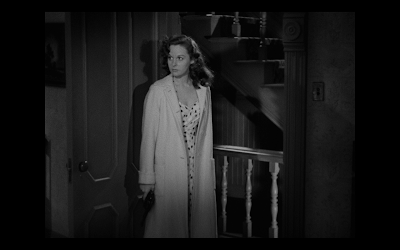
Warner
Bros., 99m 56s
The
release of HIGH SIERRA in early 1941 marked a time of genre transition,
as the decline of the gangster film coincided with the emergence of the film
noir. Themes that would become stock noir ingredients are on full
display in this classic Warner production from executive producer Hal B. Wallis
and associate producer Mark Hellinger, with master filmmaker Raoul Walsh at the
director’s chair.
Our
lead male protagonist is the "last of the big timers" according to
the theatrical trailer. After eight years' imprisonment, convicted bank robber
Roy Earle (Humphrey Bogart) is granted a pardon. Roy is not a young man anymore.
His hair is turning gray and most of his old cohorts are out of the picture for
one reason or another. Newly free, Roy shows enthusiasm for the simple elegance
of nature available at a local park, where the trees are tall, the grass is
green and children play ball. Not long after that pleasant excursion it is back
to the business for which newspapers have printed front-page stories about him.
Roy meets with Jake Kranmer (Barton MacLane), an ex-cop turned criminal working
with heist architect "Big" Mac (Donald MacBride). Roy takes an
instant dislike to Kranmer, who he does not trust whatsoever. When Kranmer
attempts to seize the initiative, Roy slaps his face in a manner only
imaginable in a movie of this vintage. Mac has engineered a scheme to rob a
ritzy hotel located near the Sierra Nevada. It is the sort of posh resort where
the sun is always shining, the pools look inviting and every woman possesses
perfect legs. Should the heist go as planned, there will be a considerable
amount of money to go around for all concerned.

Perhaps
like no other genre, the film noir reminds the viewer how past events
cling to us, especially in regard to decisions made in some haste. That moment
of recognition comes quickly in HIGH SIERRA, when the career criminal
Roy returns to Brookfield, Indiana, to visit the home where he was raised.
After engaging in some small talk with the current residents, he makes an
immediate exit after he is recognized. That scene nicely establishes two major noir
themes at work in this gangster/noir hybrid:
- The
past maintains dominion over the present; there is no going back to whatever
life was like prior to a career in crime.
- Roy
Earle may be a free man, but he is hopelessly out of place in a new decade.
The
above bullet points are reinforced in different ways by Roy's younger partners
in crime, Red Hattery (Arthur Kennedy) and the combustible Babe Kozak (Alan
Curtis). Red attempts to flatter Roy with references to his storied past, but
Roy closes the door on him. Less impressed than Red by the veteran criminal,
Babe dismisses Roy as a relic of a bygone era. That interpretation does not
work for Roy either, but both Red and Babe speak to uncomfortable truths about Roy’s
untenable position in a world poised to move on without him.
The
noir protagonist's inflexible moral code would become another key
component to the rising tide of Hollywood’s film noir output of the
1940s. That noticeable mechanism attached to Roy causes the aging everyman Pa
(Henry Travers) to believe Roy must be a good man. Such confusion would not be
unusual as the genre developed; noir criminals commonly look like
ordinary people or really are ordinary people, i.e. DOUBLE INDEMNITY
(1944), NIGHTMARE ALLEY (1947), GUN CRAZY (1950). Such characters
have little in common with the larger-than-life gangster figures that populated
1930s cinema. Roy's moral code coupled with his attraction to Pa's pretty but
lame granddaughter Velma (Joan Leslie's youthful visage) prompt him to make a
financial commitment to the surgery she requires to walk normally. Roy's last
visit with Velma is purely out of moral obligation; he understands he has
rehabilitated her for another man.
Roy's
illegal business affairs lead to his entanglement with two women: one from the Midwest, one from the West. Each
of these characters is multi-dimensional in that neither is quite what she at
first would seem, and each has an indomitable spirit, nearly impossible to
subdue or defeat. Marie (doe-eyed British actress Ida Lupino) initially is
introduced as a cheap taxi dancer whose mere presence inhibits the heist's
probability of success. Only with reluctance does Roy agree to allow Marie to
hang around. The two begin an asymmetrical relationship, Marie in love and Roy
indifferent. As Marie fears her affection for Roy never will be reciprocated,
she must wonder if her history as a dancer ever can be forgiven (the noir
past again). That concern becomes especially painful when she hears about the
"decent" woman Velma, for whom Roy has fallen. Velma is introduced as
a model of virtue, an attractive, affable young woman whose unfortunate case of
clubfoot invites sympathy. Roy senses she is inherently good and worth
pursuing, despite the fact she has a significant other back home. From an
analytical standpoint, Velma provides an early example of film noir's
many crippled characters; that her condition is cured makes her different from
any other noir character with mobility issues I can recall. Successful
surgery on her foot transforms Velma into a party girl, increasingly
insensitive to Roy's strong feelings for her. When Velma confines Roy to the
friend zone, the familiar chord of the alienated noir protagonist rings
with clean sustain (Bogart's reaction is so perfect, every man ever relegated
to "friend" must nod in agreement). Despite the appearance of
textured female characters, ultimately the viewer is left with a binary
takeaway: a woman is either one thing or
another, at least through the eyes of a man. As film noir developed into
the 1940s, the genre would become famous for dime-a-dance goodtime gals
contrasted with restrained housewife types.


Though
film noir would become associated closely with a stark urban landscape,
the big city never was a prerequisite for noir material. Various Ida Lupino
credits almost single-handedly confirm that notion, i.e. ROAD HOUSE
(1948), WOMAN IN HIDING (1950), ON DANGEROUS GROUND (1951) and THE
HITCH-HIKER (1953). HIGH SIERRA builds its noir case without
reliance upon the alienating setting of the large city identified with so many examples
of the genre. A major theme that binds film noir of all settings is that
the noir atmosphere has the potential to make its presence known
anywhere at any time. Pa exemplifies this axiom as the benign farmer from Ohio
who lost everything.
The
unmistakable existential tone of film noir is illustrated best via a
conversation that takes place between Roy and his bedridden employer Mac. His
health failing, Mac openly laments how times have changed for the worse, with
dependable fellas like Roy replaced with "young twerps, soda jerkers and
jitterbugs." According to Mac, "All the A-1 guys are gone..."
Doc Banton (Henry Hull) holds a similar world view. There is a certain freedom
that comes with this school of thought, evident when Mac goes on to define the
existentialist nature of the noir narrative with stunning clarity. As he
creates a rationalization for the drinking his physician advises against, Mac
explains to Roy, "...I'm gonna die anyhow. So are you. So are we
all." That attitude goes a long way toward explaining the characters that
would empower the film noir throughout the next twenty years.
The
stylistic flourishes that came to distinguish noir films of the
mid-to-late 1940s take center stage after Roy and Doc Banton share a vehicle.
Banton suggests Roy is "rushing toward death" just before a cut to
the dog Pard, a harbinger of tragedy as described by the caretaker Algernon
(Willie Best). Past folks associated with Pard have a shared history of
premature death. It seems there is an element of the fantastic (or maybe that noir
factor of fate) in the form of Pard's unshakable connection to Roy. The dog's
rather curious name Pard secures his bond with Roy (who recently got a pardon).
The oppressive forces of film noir invade Roy's cabin by way of ominous
shadows and compositions that suggest entrapment. Roy even experiences a
nightmare while Pard is camped out at his feet. As Algernon alone seems aware
would happen, Pard indeed precipitates Roy's death, though from the outset it
is implied Roy must perish before the film concludes. While Roy gets a dramatic
death reminiscent of the gangster of the 1930s who became a victim of his own overindulgence,
on another level his demise takes on oddly tragic proportions: his fondness for
a dog seals his fate. A reminder of the worth of Roy comes in the form of the
smug journalist Healy (Jerome Cowan), who as a total outsider provides a brief
summary of Roy's life. In other film genres the reporter essentially would be
telling the audience members how to think, though his words have the opposite
impact here. The viewer is meant to find alignment with the condemned couple
formed by Roy and Marie. Inadvertently Healy does, however, grant Marie some
solace when he recognizes Roy is finally "free" in that he will not
return to prison. The final moments of HIGH SIERRA anticipate many a film
noir's action-oriented conclusion, in which the trapped protagonist encounters
no exit.


Despite
the top-billing of Ida Lupino, this is Humphrey Bogart's picture from beginning
to end. HIGH SIERRA allowed Bogart to transition from peripheral roles
to leading man. He proves his range as an actor from quiet menace to sudden eruptions,
his trademark speech pattern always an aspect of his performance. My favorite
Bogart moment occurs when his character returns to see Velma cured of her
clubbed foot. Roy recognizes in advance the visit likely will be a painful one
for him, but he has too much character to go back on his word. It is impossible
not to side with Bogart's sad countenance, which looks unfairly trampled throughout
this emotionally painful segment. Co-writer John Huston would famously team up
with his barstool buddy Bogart for THE MALTESE FALCON (1941), the
production many consider the first full-fledged film noir, with Bogart
cemented as a singular figure in the emerging film movement. Bogart and Huston
also combined forces for KEY LARGO (1948), which like HIGH SIERRA,
merges noir concerns with the gangster's obsolescence. The Bogart persona
was well established here, with his Army veteran Frank McCloud proving himself
the better man than gangster Johnny Rocco (Edward G. Robinson), an outmoded
ogre. HIGH SIERRA's location footage captured by director of photography
Tony Gaudio, especially during the final act, makes for a convincing and highly
entertaining movie-watching experience. The Whitney Portal climactic sequence
highlights the spectacular terrain of Mount Whitney, the tallest mountain in
the contiguous United States (obviously Roy's downfall is quite literal). Also
worth a mention is Henry Travers, who portrays Pa with dignity. For a modern
audience (at least one with some classic film appreciation), Travers is among
the most recognizable of classic Hollywood actors thanks to his supporting work
in SHADOW OF A DOUBT (1943) and especially IT'S A WONDERFUL LIFE
(1946). The "mongrel" Pard is credited as Zero. He was Bogart's pet.


The
Criterion Collection's new 2-disc, dual-layered Blu-ray edition of the great HIGH
SIERRA presents a restored 4K digital transfer, with uncompressed monaural
soundtrack. Framed at 1.37:1, it is a pleasure to watch and hear and easily one
of my favorite Criterion releases of recent years.
Supplemental
material is exceptional, even by Criterion standards. Extras begin with a
featurette ported from the Warner DVD issued in 2003. "Curtains for Roy
Earle: The Story of HIGH SIERRA" (AKA "Extra, Extra, Read All
About It", 2003, 15m 6s) traces Bogart's long path to the role of Roy
Earle. I never knew Bogart's second child Leslie Howard Bogart (his only daughter,
born 1952) was named after English actor Leslie Howard, who secured Bogart the
screen role of Duke Mantee in THE PETRIFIED FOREST (1936). In effect
Howard set Bogart's Hollywood career in motion. Bogart never forgot.

The
remaining supplements are unique to Criterion. "Bogart: Here’s Looking at
You, Kid" is a documentary originally created for the television series THE
SOUTH BANK SHOW (AKA "Humphrey Bogart: You Must Remember This...",
Jan 5, 1997, 51m 7s). As produced and directed by Chris Hunt, our guide is
Stephen Humphrey Bogart, the only son of Humphrey Bogart and Lauren Bacall and
author of three semi-autobiographical books about his father and family.
Stephen describes his father as a distant figure, a loner whose nature was to
not allow others to get close to him.
Humphrey
DeForest Bogart was born Christmas Day in 1899 in an affluent area of New York
City. His is the story of the spoiled rich kid, headstrong and rebellious.
After serving in the United States Navy, Bogart found his way onto the stage.
He reportedly did not think much of the acting trade, at least not for men.
That philosophy did not endear him to his colleagues; by all accounts he was
not the easiest guy to like during this period of his life.
Bogart's
break in Hollywood occurred after his appearance in Robert E. Sherwood's play THE
PETRIFIED FOREST, which was performed 197 times at the Broadhurst Theatre in
New York in 1935. That same year Warner Bros. purchased the screen rights. The
play's lead Leslie Howard was brought onboard, and Howard insisted Bogart be
cast as well. At the age of 36, Bogart was under contract with Warner Bros.,
though he would grow disenchanted with the one-dimensional roles he was handed.
Eventually
it was HIGH SIERRA that deployed the brand of Bogart that would bring
him international recognition. THE MALTESE FALCON (1941) was an even
more crucial star-making vehicle for Bogart, ironically after the role of Sam
Spade was turned down by George Raft, who had no interest in working with
first-time director John Huston. Raft also had declined the part of Roy Earle
in HIGH SIERRA (somewhat confusingly, this documentary touches on THE
MALTESE FALCON before HIGH SIERRA, though HIGH SIERRA was
released theatrically first). The following year brought CASABLANCA
(1942), Bogart's signature film. To think this flawless work was produced at a
time when the studios cranked out a film per week in assembly line fashion;
nobody had any way of knowing what a timeless classic CASABLANCA would
become. Film critic Ty Burr notes Bogart was dependent on the commitment of his
leading ladies to bring out his romantic side; he was not much of a romantic
presence on his own. As such Bogart brought to cinemas a new type of romantic
male lead, tough and no-nonsense but always honorable.
Bogart's
four wives included Helen Menken (1926 to 1927), Mary Philips (1928 to 1937),
Mayo Methot (1938 to 1945) and of course Lauren Bacall (1945 until his death
from esophageal cancer on January 14th, 1957). From the very beginning,
Bogart's marriages were characterized by emotional outbursts, sometimes
physical, along with heavy drinking. His wives often gave as good as they got.
He met the woman who would become his fourth wife on the set of TO HAVE AND
HAVE NOT (1944). While Bogart and Bacall made THE BIG SLEEP (1946)
he remained married to Mayo Methot though very much in love with Bacall. Bogart
was drinking far too much at this point in his life, a habit that would catch
up with him. Another thorn in his side came in 1947, when The House Un-American
Activities Committee went after Hollywood. Though opposed to the investigative
committee's tactics, ultimately Bogart would create distance between himself
and the Hollywood Ten, the blacklisted writers and directors who were cited for
contempt of Congress for refusing to testify before HUAC. Like so many others,
Bogart was intimidated and opted to protect his own career.
Of
top interest to crime story fans should be the interview with screenwriter
William Riley Burnett recorded in March of 1976 (14m 24s). The author of LITTLE
CAESAR (Lincoln MacVeagh/The Dial Press, 1929), NOBODY LIVES FOREVER (Alfred A.
Knopf, 1943) and THE ASPHALT JUNGLE (Alfred A. Knopf, 1949), W. R. Burnett's
novel HIGH SIERRA (Alfred A. Knopf, 1941) was originally entitled "Rushing
Toward Death" until his publisher raised objections. Burnett describes Roy
Earle as the last member of the Dillinger gang rather than a standard gangster.
The scenic environment and the dog Pard were injected into the story to
emphasize Roy's humanity. Jack L. Warner acquired the film rights to HIGH
SIERRA for Paul Muni, an actor that screenwriter John Huston did not respect.
One night Huston got drunk and insulted Muni's capability as an actor.
Subsequently Muni turned down the script. Burnett got involved with the
adaptation under the assumption Muni could not reject the screenplay if the
author of the source material contributed. As much of the novel's original
dialog was preserved as possible, but Muni doubled down on his refusal. This
series of events predictably infuriated Warner, who approached George Raft.
Bogart convinced Raft the part did not suit him, so ultimately the role went to
Bogart. Though Bogart had his issues with director Raoul Walsh, Burnett cites
Walsh among the finest directors of action. Most interesting, Burnett believes
one of the more difficult habits for a writer to break is the insertion of
needless exposition dialog when a camera can do the work. That pattern remains
obvious in all sorts of theatrical and television content to this day.
On
deck next is an interview (14m) with film and media historian Miriam J. Petty,
author of STEALING THE SHOW: AFRICAN
AMERICAN PERFORMERS AND AUDIENCES IN 1930S HOLLYWOOD (University of California
Press, March 8th, 2016). Petty examines the career of actor Willie Best, who
made a living portraying black stereotypes for mainstream white audiences.
Characters such as the bug-eyed and cross-eyed Algernon, who walks around with
a peculiar hunched-over gait, were very familiar to moviegoers of the 1930s and
1940s. Petty notes such characters were born in material aimed at black
audiences. When these roles were repurposed for white viewers, the new context
was more socially troubling. Petty goes on to explain Algernon is not on hand
to teach us anything important about himself, he is present purely to help us
learn more about Roy Earle. A veteran of over 130 films and television
productions, Best amassed a lot of credits for a black actor of his time. Petty
wonders what type of career he might have had in an industry that supported
black actors beyond embarrassing comic relief duty. Best’s portrayal of Algernon
reflects prevailing attitudes of the time about how black actors should be
employed to make white America laugh. Petty laments, "It is hard to
imagine that there was a cultural appetite for this kind of straightforward
racism."
Also
selectable is a severely condensed radio adaptation of HIGH SIERRA (28m
26s), originally broadcast on THE SCREEN GUILD THEATER April 17th, 1944. Both
Humphrey Bogart and Ida Lupino recreated their original roles. For the sake of
time I'm sure, the plot thread that involved Velma and her family was
eliminated entirely. A theatrical trailer (2m 38s) rounds out the considerable
contents of disc one.
The
second Blu-ray disc contains a most welcome surprise with COLORADO TERRITORY
(1949, Warner Bros., 94m 30s), director Raoul Walsh’s Western reimagining of HIGH
SIERRA. The unrestored scan was derived from the original camera negative
from the Library of Congress. In other words, the transfer is not up to the
usual Criterion standards, with some film element damage apparent. Nonetheless
this as-is film is in respectable condition and makes for great viewing. The
original Burnett source material holds up remarkably well in its transformation
into a noir-Western. Joel McCrea is well-cast as Wes McQueen, an outlaw
out for one last big score, and Virginia Mayo is fetching as Colorado Carson,
the equivalent of Ida Lupino's Marie, though Colorado is far feistier.
Similarly, Julie Ann Winslow (Dorothy Malone) is a lot more driven than HIGH
SIERRA's Velma (Joan Leslie). Though I prefer the men of HIGH SIERRA,
the women of COLORADO TERRITORY have their counterparts beat. Walsh
proves with this effort he absolutely was adept at managing action sequences;
both the stagecoach robbery attempt and the train heist were superbly designed
and executed.
THE
TRUE ADVENTURES OF RAOUL WALSH (2014, 95m 12s) is a
documentary directed by Marilyn Ann Moss, the author of RAOUL WALSH: THE TRUE ADVENTURES OF HOLLYWOOD'S LEGENDARY
DIRECTOR (The University Press of Kentucky, June 2011). Moss scans the defining
moments of a filmmaking career that stretched over 50 years. Although best
known for action, Walsh was able to handle any Hollywood genre. His personality
was a good match for pictures with plenty of grit. He was a man who liked to
add color to stories about himself, some of which were blatantly untrue. Walsh
learned the filmmaking craft while working with D.W. Griffith, and proved he
was willing to take on incredibly dangerous work while on assignment for THE
LIFE OF GENERAL VILLA (1914). As an actor in THE BIRTH OF A NATION
(1915), Walsh broke his leg in an all-too-realistic re-enactment of John Wilkes
Booth's assassination of President Abraham Lincoln. As a director, Walsh first
hit one out of the park with THE THIEF OF BAGDAD (1924), the first major
American fantasy film and a huge hit. His last film as an actor was SADIE
THOMPSON (1928) starring Gloria Swanson. Walsh lost his right eye after his
car hit a jackrabbit, which effectively ended his acting.
Many
Hollywood careers stalled or were derailed altogether in the transition from
silent film to sound, especially for those who made their living in front of
the camera. Those on the other side of the camera were impacted as well. With
the advent of recording technology, the sound engineer became the most critical
judge as to what constituted an acceptable take, not the director. Walsh obviously
was one of the talents who was able to embrace sound. He thought his best
"talkie" as a director was THE STRAWBERRY BLONDE (1941)
starring James Cagney, Olivia de Havilland and Rita Hayworth. No doubt there
are many other candidates for best Walsh film, and many that were of some
historical significance, i.e. THE BIG TRAIL (1930, John Wayne's first
major role, innovative use of widescreen format), GOING HOLLYWOOD (1933,
Walsh shows ability to helm a musical), THE ROARING TWENTIES (1939,
instant success as new contract director at Warner Bros.), THEY DIED WITH
THEIR BOOTS ON (1941, Walsh becomes Errol Flynn's new director of choice), GENTLEMAN
JIM (1942, Walsh's leading men often discovered their better selves through
a woman), OBJECTIVE, BURMA! (1945, groundbreaking black & white
cinematography), PURSUED (1947, perhaps the quintessential noir-Western)
and WHITE HEAT (1949, the ultimate amalgam of gangster film and film
noir, with the crazed noir protagonist that would define the 1950s film
noir cycle front and center). Walsh believed the deaths of his frequent
male stars (Bogart, Flynn, Clark Gable) coincided with the passing of the type
of masculinity these men embodied.
The
next bonus feature is a recently recorded conversation on Walsh between film
programmer Dave Kehr and critic Farran Smith Nehme (May 2021, 19m 49s). Kehr
observes there is never the feeling in a Walsh film that the director is
judging any of the characters. Walsh seems to be following them objectively and
the viewer is encouraged to do the same. Kehr applauds the effortless flow from one scene to the next as the hallmark of a
Walsh film (a characteristic of Warner productions in general). Another Walsh staple
is the deep clarity of his shots; he did not like anything hazy in the
foreground or background. Nehme credits Walsh for encouraging actors to break
out of their comfort zones and go somewhere they had not ventured previously.
She also mentions Walsh's obvious humanism and sympathy for other people,
regardless of who they are or what they have done.
The
booklet essay “Crashing Out” by reliable film scholar Imogen Sara Smith completes
the physical media package.
W.
R. Burnett's novel HIGH SIERRA found its way to the screen a third time with I
DIED A THOUSAND TIMES (1955), directed by Stuart Heisler and starring Jack
Palance, Shelley Winters, Lori Nelson and Lee Marvin.