Saturday, February 15, 2020

TRY AND GET ME! (1950)

(aka THE SOUND OF FURY)
United Artists, 92m 18s


"...some of you guys get out here in California, and the damn place is so crazy you just gotta get something to eat some way, don't you?"
Johnny Cash, recorded live at San Quentin State Prison on February 24, 1969

Not sure if Johnny Cash knew the story of Howard Tyler (Frank Lovejoy in a gripping performance), but I have a feeling Cash would have felt something for this noir protagonist's unenviable plight. One of the doomed individuals of this high-tension noir thriller, Tyler is the type of character even casual film noir fans should recognize as prototypical:  a basically good guy who goes horribly wrong while down on his luck. Thanks to muscular direction by Cy Endfield, the emotional power of TRY AND GET ME! remains forceful almost 70 years after its initial theatrical run.

The material probably would not resonate quite as well without the performance of Lovejoy, who finds himself ideally cast as Tyler, an everyman who has found gainful employment elusive since he relocated his family to California from Massachusetts. The humiliation of unemployment is taking its toll on Tyler, who proudly gives his son Tommy (Donald Smelick) some spending money dad truthfully cannot afford to squander. And with his sweet wife Judy (Kathleen Ryan) pregnant, Tyler feels increased pressure to become a consistent earner. In a chance meeting at a bowling alley, a demoralized Tyler is befriended by Jerry Slocum (Lloyd Bridges), a flashy, self-assured man apparently doing pretty well for himself. It turns out the two attended basic training at the same location. Almost instantly Tyler is drawn to the smooth talker Slocum, who offers Tyler a job as his getaway driver. Without a doubt Slocum is the homme fatale of this narrative, always fussing over his appearance. He prides himself on expensive colognes and silk shirts. In one of my favorite scenes to emphasize Slocum's vanity, Tyler helpfully holds a mirror while Slocum runs a comb through his product-infested hair.

Annoyingly stuck with no other source of income, Tyler joins forces with the temperamental Slocum, who unleashes a detestable mean streak during his first stickup with wheelman Tyler, who does not witness Slocum preying on a defenseless old couple and their son. It is not long before Slocum sets his sights on a bigger payoff than what petty robberies make possible. Slocum and Tyler kidnap Donald D. Miller (Carl Kent), the son of a wealthy man. In one of film noir's most startling scenes, Slocum bludgeons Miller to death while Tyler grimaces. A man without compassion for anyone else, Slocum never harbored any intention of allowing Miller to survive. At this juncture, one suspects both Tyler and Slocum are in for some sort of serious retribution, but the events of the film's final act came as quite a surprise to me. If there ever were a film to go into knowing absolutely nothing about it, this is it.


TRY AND GET ME! opens with a blind preacher (Emerson Treacy) not being heard, with the local populace in an agitated state for reasons not revealed at the outset. The root cause of all this commotion is the inherent problem of a public service that functions as a for-profit enterprise. Newsman Hal Clendenning (Art Smith) is in the business of frightening readers into buying his Santa Sierra Journal. Given the recent robberies of service stations and liquor stores, the opportunistic Clendenning believes a little scaremongering will boost the publication's circulation. Thus the work of a two-bit hoodlum gets reported as a crime wave, with sophisticated out-of-towners pegged as the suspects. Somehow in the middle of all this is Dr. Vido Simone (Renzo Cesana), the rational voice for an objective press that does not strive to condition public opinion. Interestingly, the film’s man of reason is a foreigner. Simone immediately casts doubt over Clendenning's practice of injecting conjecture into reporting, and reminds ace reporter Gil Stanton (Richard Carlson) of his responsibilities to report fairly and accurately. Essentially Simone tells the viewer what to think, for instance, "...if a man becomes a criminal, sometimes his environment is defective." The filmmakers underscore that sentiment early on when they show the reporter Stanton hanging out at the same bowling alley where Tyler fatalistically encounters Slocum. As Simone strongly suggests, it indeed seems the noir environment factors in the downfall of all three of these men. Obviously the noir psychopath Slocum is positioned as the face of evil (especially in his jail cell), but Stanton and Clendenning are arguably more dangerous due to their influence over the mood of the populace. The most insidious thing about the brand of news reporting endorsed by Clendenning is the shared sense of moral superiority it cultivates in its readers. This film noir dishes out an unsparing review of yellow journalism tactics that stoke public adrenaline in the wrong direction.

In terms of genre compliance, TRY AND GET ME! enlists many of the components that had come to define the film noir approach by 1950. The noir narrative is noted for its darkness in terms of both themes and visuals, and this is a fine instance of nocturnal noir in which evil runs rampant at night. When Tyler's association with Slocum begins in earnest, Tyler tells his wife he has returned to the labor force via the night shift. He is being truthful to some degree since his "work" always takes place at night. The raucous final act also fittingly transpires during evening hours. Prior to this film, cinematographer Guy Roe had completed RAILROADED! (1947), BEHIND LOCKED DOORS (1948), TRAPPED (1949) and ARMORED CAR ROBBERY (1950). Roe's acuity of vision reveals a difference between the two condemned men in the jailhouse sequence, when the caged animal Slocum is photographed completely differently from Tyler, with whom we are meant to sympathize.


Thanks in part to the oft-present femme fatale, the film noir sometimes becomes intertwined with misogyny. That this noir entry will go down that road is apparent in the introductory sequence, when a Wells Truckways driver makes his feelings about women known to Tyler. In reference to Tyler's wife and son, the driver comments, "They sure drop the net over you, don't they?" Later the trucker continues with, "...take my old lady, and I'm not kidding, you want her you can have her." In regard to the typical female, Slocum opines, "...they're all partial to the same color:  green." Then there is the two-timing girl at the rock quarry, who explains to her date Johnny she repeatedly has made excuses with her boyfriend so she could rendezvous with Johnny.

The dates Slocum arranges for the sake of cover do not show much substance, at least when introduced. His girl Velma (Adele Jergens) likes the cash Slocum always seems to have, and he likes her idea of running off to Havana for obvious reasons. Initially Velma's manicurist friend and Tyler's blind date Hazel Weatherwax (Katherine Locke) shows little depth ("I hope he isn't bald.") but proves to be a woman of morals, "saving" herself for the right man who does not drink excessively. She also correctly senses Slocum is not trustworthy. Between her and the tender matriarchal figure Judy, who remains fiscally responsible after her husband starts to bring home some money, it might be argued that female archetypes achieve some balance. But that balance is called into question when the story's most respectable female loses everything; the scene when Judy surprises Stanton with a letter from her husband is heartbreaking. Tyler marches down the wrong path in the interest of helping his wife, and instead he destroys her. Does the narrative blame Judy? To a certain extent, it does.

Another line of analysis implies economic isolation and a propensity toward alcohol abuse combine to drag Tyler into an awful place. In the opening act we learn he owes the local market, and his wife thinks of themselves as beggars since they relocated to California. Tyler demonstrates a bad habit of throwing his money around when he does have it, a trait common to Slocum, but otherwise Tyler seems like an ordinary individual, a decent fellow. It is a lack of income that drives him into his reluctant partnership with the heel Slocum. Alcohol absolutely contributes to Tyler's downward spiral, tellingly during his first encounter with Slocum. In another hallmark noir motif, Tyler badly deteriorates mentally after becoming an accomplice to a brutal crime. While trying to maintain his composure in front of a proud new father (Bob Jellison), Tyler suffers a flashback of the murder he witnessed. His cratering continues during the nightclub sequence, where an onslaught of oblique camera angles encourages the viewer to share in his trauma. Tyler is starting to lose possession of his faculties. His breakdown finds completion at Weatherwax's apartment, where he returns in an edgy state after recognizing he no longer has any proper place at his own home. The absent or broken family is another recurring theme of the noir film, and TRY AND GET ME! concludes with the devastation of the Tyler family, along with full recognition of what an irresponsible press inflamed. This sense of loss is best expressed when Tommy is awakened by nightmares in the middle of mob rule in the story's concluding moments.


Jo Pagano's screenplay is an adaptation of his 1947 novel THE CONDEMNED, which was based upon the kidnapping and murder of Brooke Hart that took place in 1933. The alleged killers Thomas Harold Thurmond and John M. Holmes were lynched by an enraged mob of citizens in San Jose, California. It was the first time in American history that lynch mob activity mutated into a media event. Originally the film was released as THE SOUND OF FURY, but after disappointing at the box office it was reissued as TRY AND GET ME! before falling into obscurity. The same year Cy Endfield directed the film noir THE UNDERWORLD STORY, another indictment of yellow journalism. Both films raised the eyebrows of The House Un-American Activities Committee, and Endfield was declared a Communist Party sympathizer. Faced with the prospect of naming names, Endfield moved to England in 1951, where he continued his filmmaking career.

As a confirmed film noir fan for the past 30 years, it pains me to admit I never even had heard of this vitally important noir permutation until I noticed it in a Facebook post from Eddie Muller. TRY AND GET ME! debuted on Turner Classic Movies last month, with an introductory segment by Muller, a welcome listen given the absence of any supplemental material available on the Olive Films single-layered Blu-ray disc released in 2016, which served as the basis for this review. The Olive Films transfer looks outstanding framed at 1.37:1. The source material I assume is the 35mm print owned by Martin Scorsese that was restored by the Film Noir Foundation back in 2011.

Three other films were inspired by the Brooke Hart case:  Fritz Lang's FURY (1936), the short film NIGHT WITHOUT JUSTICE (2004) and Tim Boxell's VALLEY OF THE HEART'S DELIGHT (2006).


Friday, January 24, 2020

ODDS AGAINST TOMORROW (1959)

United Artists, 96m 40s


This transitional film noir from Harry Belafonte's HarBel Productions makes an ideal viewing selection for any cold, rainy afternoon. As it scratches and claws at old wounds inflicted by stubborn racial tensions, ODDS AGAINST TOMORROW is clouded with uncertainty about human nature. Its subject matter never strays far from the pessimistic title treatment. Produced and directed by the estimable Robert Wise, this would be the filmmaker's final teaming with Robert Ryan, who was so impressive 10 years previously in Wise's THE SET-UP (1949). That film examined the decline of a boxer, this one is rooted in the downfall of a former policeman who has one of those supposedly life-changing heists on the docket. "This is a one-time job. One roll of the dice and then we're through forever," according to the aging but energetic David Burke (Ed Begley), who requires two recruits to execute his simple yet ambitious robbery plan.

Burke seems to deserve his confidence in the vulnerability of the bank he has targeted, but maintains too much faith in the men he enlists for the job. The two-time loser Earl Slater (Ryan) is a bitter, lifelong drifter defined almost entirely by prejudice and bigotry. In the opening sequence, he playfully scoops up a small black girl and calls her a pickaninny. Never again will he be that pleasant with anyone. He needlessly loses patience with a hotel clerk (Ed Preble) and radiates no friendliness whatsoever to a black elevator attendant (Mel Stewart). Probably at his most reprehensible, Slater drops the N-bomb when he realizes Burke's heist requires a black man's involvement. Slater also references an old foreman as a Polack. Apparently not an animal lover either, Slater's first reaction when he notices a harmless rabbit is to open fire without reason. What probably irks him more than anything is that his much-younger girlfriend Lorry (Shelley Winters) supports him, a fact that seems to drain him of whatever positive energy he might possess. One of the most revealing moments built around Slater occurs in a barroom confrontation, when he appears to be well set up to walk away the winner. Instead he manages to leave the scene the loser after quickly dismantling a cocky young military man (Wayne Rogers) who obviously needed to be put in his place. Nonetheless Slater is perceived by onlookers as a bully who let his temper get the best of him. As directed by Wise, the persuasive sequence allows the viewer to reach but one conclusion:  the irritable racist Slater should expect to encounter no apologists.


Burke's other accomplice is much more likable than Slater, yet similarly self-destructive in his own fashion. Johnny Ingram (co-producer Harry Belafonte, top-billed) is a problem gambler, well beyond the point of no return with his major creditor Bacco (Will Kuluva). Ingram's money troubles also involve his ex-wife Ruth (Kim Hamilton), who he claims is even tougher than Bacco, "If that alimony isn't there on the first, the lawyer's there on the second." Ingram persistently shows more compassion for others than Slater, though interestingly, Ingram has his own issues with race, particularly when he condemns his progressive ex for fraternizing with whites. "It's their world and we're just living in it," Ingram preaches. Though Ruth sees a future for their daughter Eadie (Lois Thorne) in an integrated society, Ingram sees himself as a black man in a white world in which nothing changes. No doubt Slater confirms Ingram's suspicions about white folks, but the same could not be said about the more liberal Burke. A disgraced cop turned criminal, Burke treats both Ingram and Slater with respect. But when Slater gets out of line with Ingram, Burke is quick to insert himself between the two men, "...I don't wanna hear what your grandpappy thought on the old farm down in Oklahoma..." It's a great movie moment sure to stick with you.


Gloria Grahame steals a scene

Along with SWEET SMELL OF SUCCESS (1957), TOUCH OF EVIL (1958), CITY OF FEAR (1959), PSYCHO (1960) and BLAST OF SILENCE (1961), ODDS AGAINST TOMORROW is one of the significant film noir offerings that marks the end of a motion picture movement that thrived for the better part of two decades. It opens and concludes in the gutter, with the opening shot focused on storm water and trash blowing in the wind. Such a beginning announces Wise intends to wade into noir waters populated with urban bottom feeders. The water motif extends north on the Hudson River to Melton, where the bank job is to occur. Before the bank robbery, Ingram's attention is drawn to a doll entrapped by the Hudson River. Does he imagine his daughter's inevitable entrapment in a dark and murky urban environment?

The civil rights movement was well underway at the time of this film's original theatrical run, but the tellingly-entitled ODDS AGAINST TOMORROW implies a long, tough struggle lies ahead before all men might be considered equal. Slater's lack of faith in the black man Ingram leads to a badly botched heist attempt, as well as the death of the man who attempted to bring Ingram and Slater together, the man who detested old "Civil War" attitudes. The climactic sequence at a fuel depot, though an obvious homage to WHITE HEAT (1949), cleverly mocks the absurdity of racism. After the explosive confrontation between Ingram and Slater, no longer are there any noticeable differences that distinguish them. The concluding shot's sign reads "STOP DEAD END," in case anyone missed the major point about the danger of escalating racial tensions. It is not exactly an opaque outcome.

A great sense of rhythm and timing can be expected of any film helmed by Robert Wise. As he did in THE SET-UP, Wise employs an emphatic time motif, again directing the viewer's attention to a city street's clock. The nightclub sequence underscores the time element, but within the context of musical performance. Ingram commands a consummate musician's sense of time during his initial performance. But after his run-in with Bacco and his cohorts, Ingram takes the stage a second time, when he shows no discernible sense of time (his time is running out rapidly).


Cinematographer Joseph C. Brun's New York is notable for its shades of gray, not the high contrast black & white associated with the 1940s noir cycle. ODDS AGAINST TOMORROW would not be the same experience without its location work in and around New York City. Sequences were photographed in Central Park and Central Park West, Manhattan and Triborough Bridge, Bronx. Hudson stands in for the fictitious city of Melton in upstate New York. The screenplay was written by Nelson Gidding and Abraham Polonsky (front John O. Killens), who adapted the novel by William P. McGivern. As the despondent racist Earl Slater, Robert Ryan offers an inspired performance. Ryan had displayed a talent for the portrayal of similarly venomous characters in CROSSFIRE (1947), ON DANGEROUS GROUND (1951) and BAD DAY AT BLACK ROCK (1955).

My first look at ODDS AGAINST TOMORROW was courtesy of the DVD issued by MGM Home Entertainment back in 2003. From a picture definition standpoint, the single-layered Blu-ray version available from Olive Films offers an appealing upgrade, with greatly improved contrast and rich textures. The supposedly correct 1.85:1 framing, however, makes me wonder. Although IMDb.com indicates a 1.37:1 negative ratio versus a 1.85:1 intended ratio, the opening credits suggest this letterboxed version is something other than what the filmmakers intended, with some text at the bottom of the frame noticeably clipped. The screen captures below reveal how much information the Olive Films Blu-ray lacks compared to the old MGM DVD, which was framed at 1.34:1. Until someone marches forward with the definitive interpretation, I will hang on to both home video releases of this essential film noir.

Olive Films Blu-ray

MGM DVD


Berkshire Bank 561 Warren St, Hudson, NY 12534

Thursday, December 19, 2019

THE HITCH-HIKER (1953)

RKO Radio Pictures, 71m 13s


Fishing pals Roy Collins (Edmond O'Brien) and Gilbert Bowen (Frank Lovejoy) are on the road from El Centro, California to San Felipe, Baja California. After a stop in Mexicali, the men make a potentially grave error when they incautiously pick up the apparently stranded Emmett Myers (William Talman), an itinerant wanted for murder. With revolver in hand, Myers quickly assumes command of the journey, now destined for the port city Santa Rosalía. Myers offers no grain of hope for the unfortunate roadtrippers. "You guys are gonna die, that's all. It's just a question of when," he promises. In the meantime, there is not a moment without worry for Collins and Bowen. At one road stop, Myers gleefully forces Bowen to shoot at Collins in a cruel target practice session. The outlook for the would-be outdoorsmen seems especially grim when it is revealed Myers never sleeps in the conventional sense.

A compact film noir thriller textured with more than the usual grit, THE HITCH-HIKER plugs along in tight alignment with recurring noir tropes and themes. The far-reaching grip of fatalism that so often informs the noir narrative is pervasive in this instance. Only a truly indifferent universe could funnel a couple of decent guys into a ride share with a callous, sought-after killer like Myers. Another line of analysis might consider a misogynistic explanation for the significant plot points. The recreational trip planned by Collins and Bowen is spoiled after an impromptu detour into the seamier side of Mexican urban life, in memory of "a dame" as Myers puts it. Were it not for a brief look at the night life in Mexicali, perhaps another driver would have had the misfortune to encounter Myers and his outstretched thumb.


The unbalanced noir psychopath's erratic behavior of the late 1940s, best exemplified by the giggling maniac Tommy Udo (Richard Widmark) in KISS OF DEATH (1947), invaded the 1950s in forms as diverse as Chester (Neville Brand) from D.O.A. (1950), the aging has-been Norma Desmond (Gloria Swanson) clinging to SUNSET BOULEVARD (1950), the temperamental gunslinger Annie Laurie Starr (Peggy Cummins) who goes GUN CRAZY (1950), the coffee-slinging madman Vince Stone (Lee Marvin) who provides THE BIG HEAT (1953) and the disturbed introvert Leon Poole (Wendell Corey) from THE KILLER IS LOOSE (1956). One of the more contemptible villains on cinematic scorecards, Emmett Myers is the embodiment of the '50s noir psychotic, complete with diabolical laugh. From an appearance standpoint his oily skin, greasy hair and upper eyelid paralysis combine to suggest an individual one would be wise to keep at a safe distance. He shares a certain kinship with Elmo "One-Eye" Mobley, AKA Chickamaw (Howard Da Silva) of THEY LIVE BY NIGHT (1948), another disfigured noir character at large in a post-WWII society riddled with wounded men.

Persistently reckless behavior only confirms any judgment made about Myers based solely on his appearance. He not only heartlessly kills humans, but movie sin of sins, defenseless dogs that bark incessantly. His spoken word is unremittingly gruff; seldom is there any calm to his voice. Myers repeatedly employs a xenophobic attitude about Mexican people despite his plan to hide out in Mexico. And like most memorable heels of the cinema, Myers does not see himself as a social problem. He in fact congratulates himself for not participating in a debt-based society that gets people like Collins and Bowen into tough situations. Myers is proud to declare he does not owe anybody anything, and even reminds Collins and Bowen either of them could have escaped had they not felt indebted to each other. At a certain juncture in the story, Collins walks with a pronounced limp, a common noir motif that implies compromised masculinity. Nonetheless, Collins proves himself a better man than Myers, who despite all of his tough talk reveals himself to be a weak person once secured by authorities.

A criminal mug for the ages:  William Talman


In the tradition of ON DANGEROUS GROUND (1951), MOONRISE (1948) and ACE IN THE HOLE (1951), THE HITCH-HIKER is another reminder the noir film need not have primarily urban settings to create a sense of alienation and despair. When Myers, Collins and Bowen continue their journey on foot once their vehicular option has been eliminated, a Mexican desert provides a daunting noir wasteland. In another movie trend of the time, law enforcement entities prove incredibly efficient and effective. California police and Mexican authorities gladly combine their efforts for the benefit of the public. These days such selfless cooperation dates the film more than the black & white cinematography or occasionally stilted dialog ever could.

An independent production of Filmakers Inc., the company created by Ida Lupino and her husband Collier Young to manufacture social-issue programmers, THE HITCH-HIKER was inspired by the murderous exploits of Billy Cook, who went on a 22-day killing spree from Missouri to California in the early 1950s. It was directed by Lupino, who co-wrote the screenplay with producer Collier Young, by then her ex-husband. The script was based upon a story by Daniel Mainwaring, who was blacklisted at the time and thus failed to receive screen credit for his contribution. Lupino also directed two other film noir offerings, OUTRAGE (1950) and THE BIGAMIST (1953), but surely is best remembered by loyal noir fans for her appearances as an actress in HIGH SIERRA (1941), MOONTIDE (1942), ROAD HOUSE (1948), WOMAN IN HIDING (1950) and the undisputed genre classic ON DANGEROUS GROUND. Director of photography Nicholas Musuraca perfected the visual bedrock of the noir film with his mind-bendingly beautiful cinematography that distinguished director Jacques Tourneur's OUT OF THE PAST (1947). His most visually arresting work in this project comes at the concluding sequence at the docks, nicely illuminated to evoke suspense.

The basis for this review is the single-layered Blu-ray edition released by Kino Classics back in 2013, "Preserved by the Library of Congress Packard Campus for Audio Visual Conservation." Framing is at the correct theatrical aspect ratio of 1.37:1, though the packaging falsely indicates a 1.33:1 presentation.


Friday, November 29, 2019

THE SET-UP (1949)

RKO Radio Pictures, 72m 34s


In his recent explanation of why boxing is so different from most other forms of athletic competition, boxing analyst Max Kellerman described the sport as a contest of wills. A bout's outcome is determined not just by the pugilistic capabilities of the participants, but by each fighter's respective will to endure whatever punishment his opponent can deliver. Sometimes an unspectacular but durable fighter with a big heart can outlast the opposition's superior firepower. That possibility makes professional prizefighting exceptionally dangerous activity for the participants, as well as dramatic viewing material.  Everybody likes to root for a likable underdog who just won't quit when faced with serious adversity. Bill “Stoker" Thompson (Robert Ryan) is that battle-scarred fellow in director Robert Wise's THE SET-UP, a vigorous film noir that approximates real time.

The story commences with a timekeeper sounding the bell at ringside. As the narrative progresses we hear the ticking of a hotel room clock, see the hands of the town street clock and witness close-ups of the timekeeper’s clock at ringside between rounds. The uncompromising reality of time stands as the film's most crucial theme, emphasized by the recurrent images of clocks throughout the narrative as well as the stoic persistence of the lead protagonist, a journeyman heavyweight who now pensively recalls his first prizefight took place twenty years ago in Trenton, New Jersey. That is a long spell to ponder for any professional athlete, especially one trying to eke out a living in the fight game. A boxer whose time has passed and thus has become his own worst enemy makes for impactful film noir material, particularly in this case. The 35-year-old Thompson is among the most sympathetic of noir characters, punished severely and unfairly for giving his best effort in a sport that is notoriously brutal.


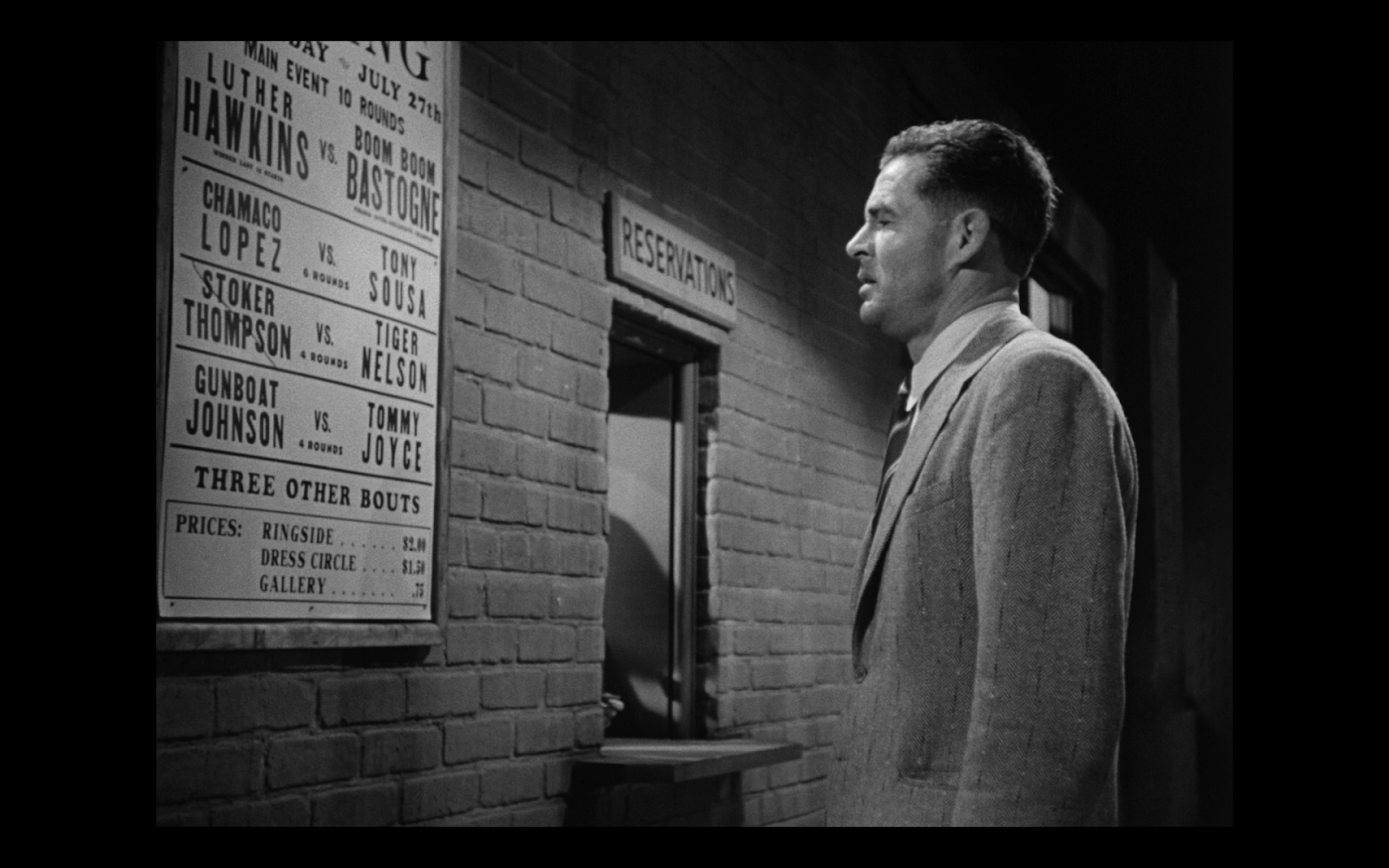
In what must feel like the supreme insult to a boxer's ego, Thompson's upcoming fight is to take place after the evening's featured event. The opponent in front of him is Tiger Nelson (Hal Baylor, here credited as Hal Fieberling), who is a mere 23 years of age. Despite the enormous age gap that separates Nelson from Thompson, money is exchanged to ensure Thompson hits the deck and stays there. In one of film noir’s most cynical gestures, Thompson's cigar-chomping manager Tiny (George Tobias) is so certain his fighter hasn't a prayer he never informs him his fight’s outcome has been predetermined! Even before that revelation, we sense Tiny does not have his fighter's best interests in mind. The moment we meet the presumably second-rate manager, he dismissively strikes a match across Thompson's name on the arena's poster, leaving a noticeable scratch over the name of the man he supposedly represents. Thompson's trainer Red (Percy Helton) is understandably skittish about the whole set-up, but he keeps quiet. With an internal support structure like that, one would hope the veteran boxer's fan base would be more enthusiastic about his next contest, but spectators are not very kind in their remarks about him, for instance:

"I remember him when I was a kid!"
"Where's your wheelchair?"
"He's an old man!"

In spite of the less than encouraging court of public opinion, Thompson stubbornly clings to the notion that he has the tools to end matters with one mighty punch. But when Gunboat Johnson (David Clarke) is dragged back to the locker room after a demoralizing defeat, the other fighters look on in knowing recognition:  someday this happens to every fighter who competes long enough. That sequence speaks to the true crux of prizefighting, which is unlikely ever to change. How does any practitioner of the sweet science call it quits when he knows he can still punch with power? It has been said for the fighter blessed with punching power that the power is the last thing to go. And when he does retire, one way or the other, to what exactly does he retire? What significant job opportunities exist for ex-prizefighters, especially those who were known to have hung around the ring past their prime? Any sentient observer might conclude there is no obvious exit strategy for the shot fighter. Those questions linger as Thompson soldiers on in boxing's no man's land, forever “one punch away” from a revitalized prizefighting career. In the meantime, he absorbs more punishment. “You’ll always be just one punch away,” declares his wife Julie (Audrey Totter, one of the few actresses I would describe as a possessor of rugged good looks). Though THE SET-UP’s runtime mostly respects actual time, the element of time is manipulated during Thompson’s climactic fight to make the brutality inside the ring even more excruciating. Round 1 clocks in at 3:17, round 2 at 3:37 and round 3 at 4:02!


The film noir of the late 1940s often doubles as a classroom session devoted to the dangerous tensions inside capitalism's underbelly, an overstuffed area bloated with class separation, cutthroat competition and unrealized dreams. The unglamorous urban setting of THE SET-UP percolates with dance halls, liquor stores, competitive newspaper salesmen, ungenerous gambling machines, street pitchmen and a wide variety of people chasing odds. It is an environment in which there are few obvious winners and a lot of average people just trying to get by on a daily basis. "Everybody makes a book on something," Thompson observes. Of primary interest in this noir city are the disturbingly bloodthirsty fight fans, who demand the most violent possible outcome to each match. The diversity of the fan base is given emphasis; one of the ticket holders is a blind man who does not allow his lack of sight to keep him far from the carnage. The montage of humanity captured inside the arena defines the term “urban jungle” better than any assortment of words ever could.


Fittingly, the major plot mechanics are empowered by the underworld business maneuvers of local gangster Little Boy (Alan Baxter), who has a significant investment in a Thompson loss. After Thompson fails to cooperate, the filmmakers make great use of the venue, both from visual and audio perspectives. Presumably the last boxing arena Thompson will navigate through is an empty one; his fighting career symbolically finished. The suddenly on-the-run Thompson attempts to avoid the representatives of the man who hemorrhaged money on Nelson's surprising defeat. As Thompson scurries around the arena in one of film noir's best "nowhere to run" concluding sequences, every sound echoes throughout the place. We recognize his time is up. On an optimistic note for an otherwise pessimistic narrative, THE SET-UP concludes with Thompson free to pursue a new life with Julie. After the moral and physical triumph in the ring, Thompson departs the sport of boxing horribly damaged, but with his life, and the potential for some sort of humble fresh start. Julie tells him “We both won tonight.” Only in a film noir could such a finish be described as an outright victory for the cinematic couple.

THE SET-UP was the first feature film screenplay credited to Art Cohn, who later co-wrote TOMORROW IS ANOTHER DAY (1951), one of the great couple-on-the-run noir titles. Cohn adapted Joseph Moncure March's long narrative poem THE SET-UP (1928), the story of a past-his-prime black boxer just freed from incarceration. Obviously the racial aspect of the poem was lost in the filmed version when a white actor was cast as the main protagonist. Nonetheless, Robert Ryan really registers as “Stoker" Thompson, one of film noir's most convincing everyman types. Still in admirable physical condition at the time of filming, Ryan was an intercollegiate heavyweight boxing champion while a student at Dartmouth College. Prolific cinematographer Milton R. Krasner worked on two other film noirs in 1949:  William Dieterle's THE ACCUSED for Paramount Pictures and Joseph L. Mankiewicz's HOUSE OF STRANGERS for Twentieth Century Fox.


A single-layered Blu-ray edition of THE SET-UP has been made available through Warner Archive, and the 1080p presentation honors their laudable standards. Based upon well-preserved 35mm source material, this welcome upgrade makes for intense viewing framed at the original theatrical aspect ratio of 1.37:1 with DTS-HD Master Audio 2.0 Mono. For noir collectors, this is an obvious must-own.

Warner Blu-ray

Warner DVD

Supplemental material is limited to an audio commentary track with Robert Wise and Martin Scorsese, ported from Warner's 2004 DVD release. Wise reveals his belief in test screenings, which allow filmmakers to repair segments that prompt unexpected audience reactions. Scorsese, who graced us with the great Jake LaMotta biopic RAGING BULL (1980), does most of the talking as he relates his obvious passion for the career of Wise. Routinely jumping from one genre to another was never an easy task, Wise just made it look easy. Scorsese applauds some of Wise's previous achievements as a director, including producer Val Lewton's noirish horror productions at RKO THE CURSE OF THE CAT PEOPLE (1944) and THE BODY SNATCHER (1945). Later at RKO Wise helmed BORN TO KILL (1947), one of the great tough-guy noirs with a memorable lead thug portrayed by Lawrence Tierney. Also mentioned are ODDS AGAINST TOMORROW (1959), one of the great noir stragglers, and the Rocky Graziano biopic SOMEBODY UP THERE LIKES ME (1956), Wise's return to the boxing film. Naturally the majority of Scorsese's focus is on THE SET-UP, which Wise recalls as his favorite film he made for RKO. From a technical standpoint, Scorsese proves himself to be an especially helpful guide. He believes it was Wise's experience as a film editor that allowed him to emerge as a master of the film medium. Wise understood when to hold the image versus when to cut. To understand the difference between the two, one must have great respect for the visual image. From an analytical perspective, Scorsese sees the boxing ring as an allegory of human life, our daily struggles encapsulated in the squared circle. He views the Penny Arcade & Fun Palace similarly, where the noir force of fate is well dramatized by the stingy crane machine that fails to pay off just when it looks like it will. In this noir city, perhaps everyone is a bit like Thompson, limping toward the end of the road, but still hopeful a big payday is out there somewhere, just “one punch away.”