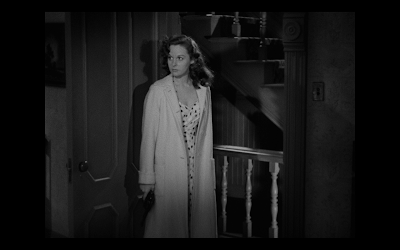
Saturday, April 30, 2022

THE ACCUSED (1949)

Paramount Pictures, 100m 58s

An independent feature produced by Hal B. Wallis, THE ACCUSED was the eleventh film released from Hal Wallis Productions, as well as his fifth film noir in a row. This title is all-out Freudian noir with its lead character in the wrong place at the wrong time. THE ACCUSED also stands as one of the genre's preeminent "woman in peril" permutations, among them DANGER SIGNAL (1945), NOTORIOUS (1946), SORRY WRONG NUMBER (1948), WHIRLPOOL (1949), WOMAN IN HIDING (1950), CAUSE FOR ALARM! (1951) and SUDDEN FEAR (1952). Furthermore, it is one of many film noirs patterned after co-writer/director Billy Wilder's DOUBLE INDEMNITY (1944), in which Walter Neff (Fred MacMurray) finds himself in uncomfortably close proximity to those investigating the murder he committed. Similarly, Dr. Wilma Tuttle (Loretta Young) of THE ACCUSED must endure firsthand reminders of an investigation closing in on her. The narrative not only revolves around the staple noir theme of mental trauma, but intertwines its psychological angle with physical abuse and physical manifestations from a fragile state of mind.

Set amid the California Coastline, the hallmarks of the noir story are plentiful: low camera angles, an obsession with mirrors, horizontal shadows cast by Venetian blinds, compositions that suggest entrapment, a flashback that reveals our lead protagonist's dire situation, and so on. Above all else, THE ACCUSED calls into question the role of psychology in American society. Is the person who represents the tenets of psychology someone to be respected? Any survey of the genre likely would suggest the answer commonly is "no." In example, consider the heel psychologists that populate CAT PEOPLE (1942), SHOCK (1946) NIGHTMARE ALLEY (1947) and WHIRLPOOL (1950).

Originally from Kansas, Dr. Wilma Tuttle is an uptight Associate Professor, Department of Psychology, at a local university. A complex, textured personality worthy of the viewer's attention, she serves as analyst and is the subject of analysis, posited as both victim of fate and unwitting femme fatale. She is anything but one thing, the byproduct of a post-WWII America still coping with where the woman belongs within a patriarchal system that might not be down for the count, but could be on the ropes. In the opening sequence along California's Pacific coast highway, truck driver Jack Hunter (Mickey Knox) tells Tuttle the last woman he encountered on the road robbed him at gunpoint. Hunter then quickly recognizes why he has happened upon Tuttle:  her choice for a date could have been contemplated better. Especially considering what we eventually learn about exactly why Tuttle was in need of a lift, an uncertain climate for both men and women can be grasped from this segment. It is implied America of the late 1940s has become a dangerous place where nobody may be what they appear to be, where neither gender has a right to feel safe.


A star vehicle for Loretta Young, THE ACCUSED cries out for a gender study reading. Though the film is progressive in certain respects and is mostly in sympathy with Young's character Tuttle, upon inspection Tuttle is defined primarily by the men that surround her. Throughout the proceedings, there is a conflict between Tuttle as elegant, sexual woman and woman of substance, as if the two cannot coexist without social disruption. In the classroom this theme is energized early, when the professor Tuttle's pencil takes on a phallic representation in direct view of Bill Perry (Douglas Dick), her bewitched student who eagerly returns the visual favor. Without a current man in her life or any suggestion of past lovers, Tuttle shows obvious signs of sexual frustration and clearly desires Perry. At the same time she judges Perry to be a brash, self-indulgent young man, though she absolutely admires his intellect. His relentless pursuit of Tuttle batters down her every defense mechanism. When he describes his interest in marine mollusks, he unknowingly compares these seemingly harmless invertebrate animals to Tuttle ("They can really get you."). America may be a place fraught with danger, but both Perry and Tuttle demonstrate they are attracted to danger, even if that fascination in either case is of the unconscious variety.


The male gaze

Perry drives Tuttle to an isolated Malibu cliff some 75' above the shore, where he forces himself on her to the point she repeatedly asks him to stop hurting her arm. Undeterred, Perry is convinced Tuttle in truth is turned on by his brutish behavior. In response to his rape attempt, Tuttle beats Perry into a permanently non-aggressive state. Though Tuttle acts in self-defense, she fears the events of the evening easily could be misinterpreted and bring about career-wrecking scandal. Tuttle is indeed the "cyclothymiac cutie" of Perry's essay, the unassuming woman talked into an impromptu date with him on what will be the last evening of his life. He correctly describes her as a sexually-repressed woman struggling with unfulfilled desires. So accurate is his assessment of Tuttle that his essay, ironically ordered by Tuttle, acts as the catalyst for her potential downfall. There is compelling evidence Perry understood his subject well when Tuttle's psychic trauma attacks her body; at one point she lands in the hospital with pneumonia, at another she collapses into a piece of office furniture. And while enveloped by the bloodlust of ringside fans at a boxing event, her faculties break down completely when she envisions the unwelcome visage of Perry in the ring. It is unsurprising that the truth just has to come tumbling out; all along we sense Tuttle has too much character to live with her concealed crime forever.

Though Tuttle is a respected professor who projects upward mobility, at the same time she is objectified and lives at risk of the men who would like to contain her, as when Warren Ford (Robert Cummings) announces their imminent marriage without bothering to consult her on the subject. Whether she is to be blamed for that fateful night at a precipitous cliff is a difficult question, though in light of the last close-up of Loretta Young, it seems axiomatic the filmmakers stand firmly on her side. That the jury would be sympathetic to Tuttle based upon her crime's circumstances is laudable, particularly with the first-hand knowledge of that terrible seaside night the viewer is granted. Unfortunately, we are left with the impression Tuttle will be set free thanks to her enchanting good looks, which hardly implies the equality of all citizens in the courtroom or any sense of fairness. The other major takeaway is equally troublesome:  the intelligent woman is more capable of deception and thus should be considered the most threatening type of woman. Interestingly, Tuttle's capacity to kill does nothing to discourage the attention of homicide officer Lieutenant Ted Dorgan (Wendell Corey), who finds Tuttle irresistible, even in the courtroom! Her beauty has a borderline hypnotic command over him; again it isn't just Tuttle who is drawn to danger. The implication is disconcerting; the more dangerous Tuttle might be, the more attractive she becomes. Tuttle the professor has no suitable male callers begging for her hand, Tuttle the murderess has options! Is dangerous living really that entrenched in American life? Dorgan seems to understand that possibility best when he sets Ford straight about homicide investigation work:


"You want the illusion that youth means innocence? Today kids kill their parents, their grandparents, children killing children. Sweet sixteen. They murder their lovers."

Susan Duval (Suzanne Dalbert), an immigrant student, is one of the peripheral characters that reflects Dorgan's cynical life philosophy. She very much likes Perry, but he treats her poorly, to the extent she says she could kill him (it is not directly stated, but strongly implied Perry impregnated Duval).


If Tuttle is contextualized in terms of the male gaze, the male characters are united by a fairly consistent train of thought about a woman’s place. Although the narrative is constructed around an ambitious, career-oriented woman, that character is observed through an unmistakable prism of antiquated patriarchal power. There is evidence that men are both empowered and weakened by the female, especially when the woman happens to be alluring. Dorgan confesses a "blind spot" that sometimes gets the best of him. Naturally that flaw is a fondness for beautiful women, whose distracting charms and tendency to be "gabby" interfere with his professional duties as a homicide investigator. Similarly, Ford admits he fell for an accused female in the past without any clue he is wandering down that identical path with Tuttle. He also suggests beauty and brains should not (or perhaps cannot) exist within the same feminine body. Even the truck driver Hunter flirts with Tuttle; no man can seem to help it. And then we have Perry, another of noir’s decidedly negative psychiatrists given his rather self-serving analysis of his “cutie” instructor.

THE ACCUSED is based on the 1947 novel BE STILL, MY LOVE by June Truesdell. The adaptation for the screen was written by Ketti Frings, an eventual Pulitzer Prize winner. For whatever reason there were uncredited contributions from six(!) contract writers (Jonathan Latimer, Barré Lyndon, Allen Rivkin, Robert Rossen, Charles Schnee, Leonard Spigelgass). This is an unusual film noir in that both the source material and its script were credited to women. It was directed by William Dieterle, who would helm additional noir productions for Paramount Pictures such as ROPE OF SAND (1949) and DARK CITY (1950), again for producer Hal B. Wallis, and THE TURNING POINT (1952) for producer Irving Asher. Cinematographer Milton R. Krasner's noir credits include many of my favorites:  THE WOMAN IN THE WINDOW (1944), SCARLET STREET (1945), THE DARK MIRROR (1946), THE SET-UP (1949), HOUSE OF STRANGERS (1949), NO WAY OUT (1950), DEADLINE - U.S.A. (1952) and VICKI (1953). There is a lot to like about the supporting cast installed around Loretta Young, especially Wendell Corey, who excels as Lieutenant Ted Dorgan. Robert Cummings also was an inspired choice as Warren Ford, Perry's legal guardian and attorney. Douglas Dick is suitably slimy as the well-documented womanizer Bill Perry, another of film noir's unstable veterans. Sam Jaffe (THE ASPHALT JUNGLE [1950]) is in his element here as Dr. Romley, and even in a small role, it is always reassuring to see Henry Travers (HIGH SIERRA [1941], SHADOW OF A DOUBT [1943], IT'S A WONDERFUL LIFE [1946]). The billboard for the Macdonald Carey / Gail Russell movie "Murder" is injected cleverly, though the title referenced is fictitious.

This single-layered Blu-ray release from Kino Lorber was derived from a somewhat bespeckled print, congested with scratches and various artifacts. Contrast is average at best, but despite the less than perfect source material, the movie looks solid in motion with an appropriate level of film grain. Bottom line this is an important film noir and yet another notable addition to the Kino Lorber Studio Classics product line. Framing looks correct at 1.37:1.

The audio commentary track by film historian Eddy Von Mueller is new to this Blu-ray edition of THE ACCUSED. Von Mueller notes the film was released at a time when long-term attitudes about social norms were being challenged. THE ACCUSED is rooted firmly in the time of its creation, a time of "horrific moral decay," with a telling reference to the Black Dahlia (the gruesome, still unsolved murder of Elizabeth Short in 1947). Von Mueller recognizes brainy women historically are presented as a problem in cinema, particularly when they occupy a position of power over men. The Tuttle character challenges every man she encounters one way or another. Despite the fact her violent actions were only out of self-preservation and understandable under the circumstances, her narration reveals a split in her consciousness, a variation on the doppelgänger theme that distinguishes numerous film noirs, quite overtly in SHADOW OF A DOUBT (1943), PHANTOM LADY (1944), THE DARK MIRROR (1946), STRANGE IMPERSONATION (1946), STRANGERS ON A TRAIN (1951) and BEYOND A REASONABLE DOUBT (1956). Both Tuttle and Dorgan make direct reference to the theme of doubles, and the recurring mirror motif hammers down the same point.


Von Mueller's commentary is not without its memorable sound bites, as when he critiques outrageously sexist dialog, "'Your brains don't show a bit.' Jesus. This is the good guy, folks!" Another winner comes as he recalls that Mickey Knox's wife's sister Adele Morales was married to Knox's good friend Norman Mailer, who almost stabbed Morales to death. "Norman Mailer was a dick," summarizes Von Mueller. He concludes his excellent, highly professional track with an extraction from the courtroom sequence, dialog that encapsulates the very essence of film noir, "It's always a fine line between what we cause to happen and what happens to us."

A theatrical trailer collection includes a trailer for THE ACCUSED along with trailers for a host of other comparable titles available from Kino Lorber.


Sunday, March 27, 2022

STEP BY STEP (1946)

RKO Radio Pictures, 61m 51s

A lively film noir programmer from good ol' RKO, director Phil Rosen's STEP BY STEP makes for an entertaining Saturday afternoon diversion. Set along California's coastline, this taut noir plunges the viewer into post-WWII malaise, with rogue Germans still very much a nuisance to American ideals. Stuart Palmer's screenplay, based on an original story by George Callahan, exploits the concern that Nazism has metabolized into the country's social and political structures. In its implication that evil never can be entirely defeated (it just regroups and starts over), the atmosphere advanced in STEP BY STEP is no place for the weak-kneed or the uninformed. Though the war may be over, the isotropic tension of aggressive Nazism might manifest itself in person, via listening devices or through one's own compromised employee.

At his seaside home, Senator Remmy (Harry Harvey) suggests his newly-hired secretary Evelyn Smith (Anne Jeffreys) enjoys the beach while he awaits the arrival of James Blackton (Addison Richards), a government operative who possesses a list of 200 Germans whose day-to-day actions deserve monitoring. On her way to the beach, Evelyn draws the hungry eye of Johnny Christopher (Lawrence Tierney), recently discharged from the United States Marine Corps after being stranded in the South Pacific. The two have a friendly conversation, but nothing happens beyond talk. Evelyn returns to the Remmy beach house and eventually is followed by Johnny, who is floored to be greeted by another blonde (Myrna Dell) who claims to be Evelyn!


STEP BY STEP qualifies as a film noir thanks mostly to its unstable environment where the order of things is questioned and ordinary people inspire doubt. Our lead protagonist Johnny stands among a vast array of noir characters who served their country only to encounter continued opposition back in the states. This theme pervades the narrative early when a motorcycle traffic cop (Pat Flaherty) accuses Johnny of being a shell-shocked veteran whose perceptions cannot be taken seriously. An unhelpful public servant, the cop does not buy into the former Marine's story and is outwitted easily by the Nazis led by Von Dorn (Lowell Gilmore) who have assembled at the Remmy estate. The battle-tested noir doppelgänger theme is emphasized by this German crew that substitutes for Remmy and Evelyn without much resistance. Effectively the Nazis put Johnny and Evelyn on the run, with the couple sought by both police and criminals.

Particularly for film noirs of this period, the woman of mystery is one of the accepted genre conceits. It is hinted at very early in the proceedings that Evelyn Smith might not be who she claims to be in terms of work history. On a related note, she is an outsider from the east. Though not a femme fatale per se, from the opening segment there is question as to who she is and why she suddenly has become a secretary for Senator Remmy. In fact she eventually reveals she was selected for the job based on false credentials, and thus never should have been in a position to attract Johnny with her fetching swimwear. Interestingly, Evelyn proves she is capable of spider woman detail when she tricks the chauffeur Norton (Phil Warren) into admitting his treachery just before he gets iced.


The requisite heterosexual union (well, sort of)

Ultimately the Nazi fugitives are expunged as Hollywood conventions of the time required, although the cathartic concluding sequence strains credulity to the limit, with law enforcement firepower responding to a wildly implausible S.O.S. signal engineered by Johnny. Overall the plot seems heavily dependent upon coincidence rather than the preferred film noir power of fate. STEP BY STEP reunites Lawrence Tierney and Anne Jeffreys from DILLINGER (1945), though it should be mentioned this vehicle is hardly the forum for the unique talent of the real-life bad boy Tierney, who was so effective the following year as the heavies in THE DEVIL THUMBS A RIDE (1947) and BORN TO KILL (1947). Myrna Dell's character Gretchen is branded repeatedly as far less attractive than Evelyn, as if Dell were some sort of ugly duckling. Not only are Nazis engaged in nefarious activities that threaten our basic freedoms, the viewer is to understand their women are homely to boot.

This Blu-ray presentation is derived from outstanding source material and looks smooth and crisp in motion, framed at the original theatrical scope of 1.37:1. Two bonus features are selectable. The first is THE TRANS-ATLANTIC MYSTERY (1932, Warner Bros., 21m 40s) with Ray Collins, who would later appear as Boss Jim Gettys in CITIZEN KANE (1941). John Hamilton from STEP BY STEP is also part of the cast. The second supplement is “The Great Piggy Bank Robbery” (1946, Warner Bros., 7m 33s) a surreal animated short starring Daffy Duck.


Saturday, February 26, 2022

NIGHT HAS A THOUSAND EYES (1948)

Paramount Pictures, 80m 56s

After a man acquires the power of second sight, he comes to understand his inexplicable ability as more of a curse than a blessing. He becomes a loner, effectively closed off from the world around him. When he realizes he may be able to alter one of his visions, he senses such intervention may cost him his life. If that brief plot summary brings to mind director David Cronenberg's THE DEAD ZONE (1983), based on the novel by Stephen King, it should. One wonders if King found some inspiration for his story in director John Farrow's NIGHT HAS A THOUSAND EYES, or perhaps in that film's source material written by Cornell Woolrich. After screening the Farrow film, it occurred to me that THE DEAD ZONE might best be discussed in film noir terms, but that will be an essay for another day.

NIGHT HAS A THOUSAND EYES is among the best calibrated of noir films that focus on an alienated individual doomed to a bleak outcome. Like many noirs of this period, it begins at the end, but then journeys backward in time to shed light on what brought the major characters to where they find themselves. In this case the flashback takes us back 20 years to 1928 Louisiana, where John Triton (Edward G. Robinson) makes his living in a "first-class phony" mind reading act. Billed as "Triton, the Mental Wizard," he is flanked by his fiancée Jenny (Virginia Bruce) and his close friend Whitney Courtland (Jerome Cowan). Each night the trio stands before appreciative spectators, all primed to believe in Triton's reputed clairvoyance. One night Triton is inclined to believe it too after he learns his sudden impression of a boy in danger proves stunningly accurate. Then a 10-1 longshot comes through at the horse track per Triton's intuition. Triton grows increasingly fearful of his forewarnings after the death of a newsboy (Georgie Nokes), but Courtland repeatedly reaps pecuniary rewards. Winning bets on horse races lead Courtland to stock market success and tracts of land rich with oil in Oklahoma. After a particularly disturbing vision drifts through his consciousness, Triton abandons Jenny and Courtland. "I'd become a sort of a reverse zombie. I was living in a world already dead, and I alone knowing it."


As Courtland rises to the top of society thanks entirely to Triton's incredible powers of precognition, Triton is absorbed into oppressive noir nothingness within Los Angeles, where he lives alone and operates the Triton Novelty Co., a small mail order service. The mentally traumatized film noir figure was a common sighting in noir output of the late 1940s, almost a prerequisite, i.e. HIGH WALL (1947), NIGHTMARE ALLEY (1947), POSSESSED (1947), MOONRISE (1948), SO EVIL MY LOVE (1948), THE CROOKED WAY (1949) and WHIRLPOOL (1949). The psychologically haunted protagonist of NIGHT HAS A THOUSAND EYES is Triton, a man who once had a place in society when he pretended to be a mentalist. In one of the genre's most darkly ironic twists, Triton comes to possess actual paranormal power only to be destroyed by it after two decades of misery. Some of his dialog is instructive as he describes his life of anonymity in the Bunker Hill neighborhood using absolute film noir verbiage:


"It was an odd part of the city, but I liked it. It was a strictly 'no questions asked' area; people minding their own business and letting you mind yours. Even after 15 years my social conversation didn't exceed 25 words a day...it was a lonely life..."

Other than significant financial gain for his friend Courtland (a dubious benefit as it turns out), there is no plus side for Triton that comes from his foresight. He has no control over his premonitions, which strike without warning and always seem to bring the worst imaginable news. Triton effectively forfeits his fiancée Jenny to his friend Courtland in the hope of altering his vision of her death, nonetheless she dies during childbirth. Triton eventually envisions Courtland's death by plane crash, but is unable to prevent it, try as he might. Then Triton foresees the imminent death of Jean (Gail Russell), the daughter of Jenny and Courtland. Ultimately both Triton and Jean join the ranks of film noir's walking dead, those unenviable folks who can see their own demise. This was another common film noir trope of the mid-to-late 1940s, as seen in THE DARK CORNER (1946), THE KILLERS (1946), OUT OF THE PAST (1947), RIDE THE PINK HORSE (1947) and ACT OF VIOLENCE (1948).

Portrait of Jenny


In a sequence that connects the main protagonist directly to the viewer, Triton posits he is not that different from anyone present at the Courtland estate:


"You've been there, all of you. You've had experiences:  telegrams that you knew the contents of before you opened them, places that seem familiar though you've never been in them before, and under the emotional stress of tragedy, have you noticed how everything becomes disturbed and unreal as the mind tries to escape into time? And in dreams, it escapes too; not always into fantasy, sometimes the dreams come true."

By inference, none of us are much different than Triton as he attempts to explain how unremarkable he believes himself to be. The notion that the lead protagonist could be anybody is a powerful attribute for any film noir; it allows the audience to identify with people who are not always likeable, though it is easy to sympathize with Triton as he copes as best he can against unyielding film noir doctrines. Later at the police station, he reminds us of the absurdity of his position, how powerless he is within the context of film noir conditions:


"This gift, which I never asked for and I don't understand, has brought me only unhappiness."

That moment of recognition extends to Elliott Carson (John Lund), the oil geologist. The man of science maintains a skeptical attitude throughout the film, but ultimately comes to a certain respect for the fatalistic noir universe and its mysterious functions. He admits scientists indeed are conducting studies in the area of second sight, which in itself seems to legitimize the possibility of such phenomena.

A diagram of interconnected film noir themes and motifs is created through an emphasis on darkness, low camera angles, elaborate staircases, mirrors, an idealized portrait and an overwhelming sense of dread. Repeatedly Triton's grim prognostications are associated with rainfall. Of course rain-soaked streets provide a film-friendly terrain for noir sequences, but there is a deeper meaning attached to water, which is linked symbolically to ominous transitions in film noir narratives such as DOUBLE INDEMNITY (1944), THE WOMAN IN THE WINDOW (1944), MILDRED PIERCE (1945), BRUTE FORCE (1947), PORTRAIT OF JENNIE (1948) and SUNSET BOULEVARD (1950).


The noir mirror

A veteran of some of the genre's undisputed classics, including DOUBLE INDEMNITY, THE WOMAN IN THE WINDOW, SCARLET STREET (1945), THE STRANGER (1946), KEY LARGO (1948), HOUSE OF STRANGERS (1949) and ILLEGAL (1955), Edward G. Robinson is at his most affable here as a man plagued by what many would assume to be a wonderful gift. Director of photography John F. Seitz possessed a noir credit list arguably as impressive as Robinson's, including DOUBLE INDEMNITY, CALCUTTA (1946), THE BIG CLOCK (1948), APPOINTMENT WITH DANGER (1950) and SUNSET BOULEVARD. The compositions captured by Seitz for NIGHT HAS A THOUSAND EYES now can be appreciated in the recently released single-layered Blu-ray edition from Kino Lorber. The new 2K master does look a little darker than what I would have preferred, though grain level is appropriate. Minor speckles, scratches and artifacts are evident throughout the presentation, but none of these little annoyances detract from the viewing experience in any significant way.

The new Blu-ray disc features an audio commentary track recorded by Imogen Sara Smith, a voice to be trusted on all things Hollywood. Her research is so thorough it really poses a problem for those of us trying to take notes; this commentary in particular made me appreciate the pause button on my remote control. Smith approaches the film from every imaginable angle. She notes that the supernatural element is uncharacteristic of the film noir; consequently the lead protagonist is not the fraud Stan Carlisle (Tyrone Power) is in the prior year's NIGHTMARE ALLEY. Also unusual for a noir exercise is that none of the major characters are motivated by greed, lust or hatred—only fear of their own mortality. Noir stories often are concerned with the power of the past over the present, and that is true to some extent in this film given the textbook flashback format. But the more meaningful focus is on Triton's unpleasant premonitions about the future, which makes this film noir especially cynical in its thematic structure. Something that seems like a gift in reality is a heavy cross to bear. Smith observes the adaptation (by screenwriters Barré Lyndon and Jonathan Latimer) is not particularly faithful to Cornell Woolrich's source novel (NIGHT HAS A THOUSAND EYES, 1945, written under the pseudonym of George Hopley). Triton was not the lead character in the novel, which is even more obsessed with the inevitability of death than the film version. The doom-laden novel was constructed around Courtland and his daughter Jean, with Triton as a secondary character.

The film's second reel comes with a somewhat incongruous change in tone thanks in part to the presence of William Demarest, who portrays the wisecracking Lieutenant Shawn of the homicide division. Demarest was an actor noted more for his work with director Preston Sturges than film noir productions. As the action plays out at the Courtland home, there is more of a comic flair to the proceedings than noir fans might expect or want. Smith suggests this might be explained by the fact this film is a product of Paramount, a studio not known for gritty films. Thus the stable of actors called upon for supporting roles are more notable for their achievements in genres other than film noir. At this point director John Farrow is best remembered for his work in film noir, i.e. CALCUTTA, THE BIG CLOCK, ALIAS NICK BEAL (1949), WHERE DANGER LIVES (1950), HIS KIND OF WOMAN (1951) and A BULLET IS WAITING (1954). His noir films are united by consistent themes that include control, manipulation, loss of identity, fatalism and absurdism. He favored the complexity of long takes with multiple actors in the frame. This approach was more demanding of everyone involved, and demanding he was. Farrow had a reputation for being a tyrant on the set with a horrible mean streak. He also was "a chronic philanderer" according to Smith. The House Un-American Activities Committee (HUAC) impacted almost every film for which Smith has submitted a commentary track. HUAC really hurt Edward G. Robinson's career; NIGHT HAS A THOUSAND EYES came toward the end of his run as an A film actor. The story of Gail Russell is far more tragic; the underconfident actress drank herself to death at the age of 36. Smith points out Angels Flight in the Bunker Hill district of Downtown Los Angeles was a landmark film noir setting that formed the backdrop for genre entries such as SOMEWHERE IN THE NIGHT (1946), ACT OF VIOLENCE (1949), M (1951) and the great KISS ME DEADLY (1955). The usual assortment of theatrical trailers for discs available from Kino Lorber completes the supplemental package.

The song "The Night Has a Thousand Eyes" was composed by Jerry Brainin, with lyrics by Buddy Bernier. Since the movie made its theatrical run, the song has become a jazz standard, recorded by a vast assortment of artists such as John Coltrane, Sonny Rollins, Horace Silver, UAB SuperJazz (featuring Ellis Marsalis), Harry Belafonte, Paul Desmond (with Jim Hall), Toshiko Akiyoshi, Pharoah Sanders, Irene Kral, Harry Beckett, Petula Clark, Gloria Lynne, and Carmen McRae.


Sunday, January 30, 2022

AMONG THE LIVING (1941)

Paramount Pictures, 69m 9s

An undervalued noir-horror composite ripe for rediscovery, director Stuart Heisler's AMONG THE LIVING is a veritable movie milestone for those fascinated with film noir and horror. New to domestic home video thanks to the always reliable folks at Kino Lorber, this Paramount production contains a mélange of crucial elements that would influence both the horror film and the emerging film noir genre.

As the curtain rises, businessman Maxim Raden has departed. He built Radentown, but ultimately put a large portion of area residents out of work with the closure of his textile mill. After a 25-year absence, his son John Raden (Albert Dekker) has returned home with his wife Elaine (Frances Farmer) for his father's send-off. It was 25 years ago John's twin brother Paul (also Albert Dekker) was buried, or so John was raised to believe. But according to Dr. Ben Saunders (Harry Carey), Paul lost his sanity as a child after witnessing his father assaulting his mother. Paul attempted to intervene when Maxim physically lashed out at the boy, which permanently compromised his son's state of mind. Maxim sent John away while Ben falsified Paul's death certificate. It is soon revealed Paul in fact is among the living, though confined to a straitjacket in a secured sector of the Raden manor, where he has lived in isolation, his unsteady mental state allowed to fester.

Paul goes berserk when he learns his cruel father is to rest next to his beloved mother. After he learns his brother is alive and has broken free from home imprisonment, John wants to involve local law enforcement. In the interest of avoiding public scandal, Ben convinces John the matter should be handled privately. Unsurprisingly, Paul loves his new freedom to wander wherever he wishes, but proves himself completely clueless about how to make a move on the cute brunette Millie Pickens (Susan Hayward), who is taken in by his well-meaning clumsiness. But there is nothing cute about Paul loose on the streets after the discovery of the murdered caretaker Pompey (Ernest Whitman), who is found positioned in such a way to suggest the impenetrable mental issues embedded deep within Paul's fragile psyche.


Impressive matte effect for its era

In the 1940s, the horror genre underwent its slow transition from classic Universal monsters to Paramount's landmark PSYCHO (1960, long since distributed on home video via Universal). RKO producer Val Lewton often is credited for spearheading horror's dark new path from horrific appearances to horrific minds, starting with his first RKO B-horror effort CAT PEOPLE (1942). AMONG THE LIVING anticipates the Lewton approach, particularly with the character Paul, who looks completely normal but has lost any grip on sanity he ever had. Though not a monster from an appearance standpoint, Paul is exactly that from a psychological perspective. His condition easily can be traced back to irresponsible, selfish behavior on the part of those who should have cared for him (thus Paul is a sympathetic figure). With its victim of physical and psychological abuse Paul, a prisoner since childhood, AMONG THE LIVING paves the way toward PSYCHO in its implication that untethered evil emanates from within the traditional family. Maxim Raden's faculties must be questioned here as well:  his plan was to hide his son in one room of his house indefinitely?

A story of brief runtime but considerable dimensions, AMONG THE LIVING is composed of critical elements that would find their way into a towering silo of standard film noir themes and motifs. In a transitional theme that merges horror concerns with film noir functions, the horrors of the past shape the present day. Abused by his domineering father, Paul remains tormented by his mother's screams. Maxim Raden may be dead and unable to mistreat his wife any longer, but Paul continues to hear her screams. The psychologically tormented man Paul prefigures mentally traumatized characters that would populate noir films such as THE BLUE DAHLIA (1946), NIGHTMARE ALLEY (1947), MOONRISE (1948) and ACT OF VIOLENCE (1949).

Already dangerously disturbed, Paul is dragged to an even lower level by the fatalistic film noir climate, especially at the crazed atmosphere of the appropriately named River Bottom Cafe, where an out-of-his-element Paul is targeted by Peggy Nolan (Jean Phillips), a tempting blonde. A heightened sense of trauma is well illustrated in the nighttime tavern scene, where Paul learns the hard way about the effects of alcohol on the human body. The combination of alcohol and his tortured mind makes him ill-equipped to deal with the frenetic pace the club encourages on and around the dance floor. Bodies twist and contort, women screech, faces get slapped. The evening culminates with a chilling chase that leads to murder in a dark alley.


A noirish chase down rain-soaked streets

In its evocation of mental illness, AMONG THE LIVING communicates the sense of alienation experienced by its protagonist Paul. He wants to be like everyone else, but he cannot because he isn't. An alienated existence forms the backbone of many a film noir, i.e. HIGH SIERRA (1941), DETOUR (1945), POSSESSED (1947) and TOMORROW IS ANOTHER DAY (1951). The horrible toll of imprisonment sometimes provides a related theme, again in HIGH SIERRA, TOMORROW IS ANOTHER DAY and even more explicitly in MY NAME IS JULIA ROSS (1945), BRUTE FORCE (1947) and CAGED (1950). That lack of belonging or purpose in an impersonal society frequently is accompanied by an irreversible sense of doom, sometimes equated with a dead-man-walking theme, as seen in THE KILLERS (1946), THE DARK CORNER (1946), DECOY (1946), RIDE THE PINK HORSE (1947), OUT OF THE PAST (1947), ACT OF VIOLENCE (1948) and most obviously in D.O.A. (1950).

An irresolvable sense of long-term corruption traces the contours of most every legit film noir. In AMONG THE LIVING that notion is personified by the murky motives of Dr. Ben Saunders, who has a history of placing his private life ahead of professional duty. Ben falsified Paul's death certificate, pressures John to avoid working with the police on Paul's escape, indicates Pompey died of heart failure though he obviously was strangled, and initially refuses to deliver testimony that would clear John from his brother's wrongdoing. An atmosphere of intense corruption is sure to ignite social tensions, as we see in the form of an implausibly large group of unruly locals who quickly agree to take matters into their own hands when it comes to the murderer on the prowl. A $5,000 bounty for the killer's capture whips them into a lawless frenzy that anticipates the noir cult classic TRY AND GET ME! (1950). The corrupting power of money is readily apparent in the malcontent Millie, a noir femme fatale prototype driven primarily by material things. Anything to do with money seems to maintain an almost hypnotic pull on her. When she tries on a new dress, her legs are fetishized to connect her sex appeal with a man's purchasing power. She really gets off on the idea of that reward money, which could outfit her in a new fur coat (that timeless movie indicator of a woman's status; a woman either has one or wishes for one).


Albert Dekker is highly effective in his dual role as the twins. His other film noir appearances include EXPERIMENT PERILOUS (1944), THE KILLERS (1946), KISS ME DEADLY (1955) and ILLEGAL (1955), an exceptional noir film I need to get around to reviewing one of these days. Director Stuart Heisler was at the beginning of his Paramount contract days with AMONG THE LIVING. Over the course of his career he would work in various genres. His other film noir credits include THE GLASS KEY (1942), another formative noir classic, and I DIED A THOUSAND TIMES (1955), a reimagining of HIGH SIERRA. Cinematographer Theodor Sparkuhl again worked with director Heisler on THE GLASS KEY. Co-screenwriter Garrett Fort also co-wrote the screenplay for FRANKENSTEIN (1931). The angry mob of AMONG THE LIVING certainly draws parallels to the sci-fi/horror classic. Co-screenwriter Lester Cole was one of the Hollywood Ten, a group of screenwriters and directors cited for contempt of Congress and ultimately blacklisted for alleged ties to the Communist Party. Cole was raised as a socialist and was an unapologetic Communist Party member as an adult, which or course got him in the crosshairs of the House Committee on Un-American Activities. Ironically troubled actress Frances Farmer, whose assignment was limited in this film, was struggling with alcoholism and paranoid schizophrenia at the time of filming.

The new Kino Lorber Blu-ray presentation of AMONG THE LIVING is framed at the original theatrical aspect ratio of 1.37:1. The source material shows occasional damage but overall looks really good in motion. This release should be considered a must-own for genre movie fans. The major supplement is an audio commentary track by accomplished film scholar Dr. Jason A. Ney, Director of the Writing Center and Assistant Professor of English at Colorado Christian University. Ney has contributed frequently to the Film Noir Foundation publication NOIR CITY and is in his element with this critique of AMONG THE LIVING's credentials as an early film noir and a transitional horror film in which fears and anxieties are grounded in reality rather than the world of the fantastic. The interplay of genres is apparent from the opening sequence, when the "decrepit house" horror motif interlocks with the brand of class tensions that would define so many noir films going forward. He mentions several films that anticipate AMONG THE LIVING, including THE BLACK ROOM (1935), a Boris Karloff horror vehicle that revolves around an evil twin. THE BLACK ROOM served as a noir bridge to THE DARK MIRROR (1946), with Olivia de Havilland's famous portrayal of twin sisters. Ney also notes Harry Carey had starred in BURNING BRIDGES (1928), a Western with a plot structure quite similar to that of AMONG THE LIVING. Director Stuart Heisler learned how to merge genres into one film with THE MONSTER AND THE GIRL (1941), the film he made prior to AMONG THE LIVING.

Ney helpfully identifies AMONG THE LIVING's major film noir components as follows:

  • A deeply cynical view of human nature.
  • An unflinching exploration of damage caused by human weakness.
  • A critique of the American city as a place of isolation and despair.
  • Bleak fatalism with a protagonist doomed to a sad ending.

Ney argues that Heisler's chase sequence that ends with the murder of Peggy Nolan holds up well even by today's standards with its careful progression from terror to horror. He also is on solid ground with his evaluation of Millie as femme fatale. She uses her sexuality to steer Paul in the direction of her own agenda, then questions his masculinity when his compliance loses momentum.

The Blu-ray disc also includes an assortment of trailers for additional titles available from Kino Lorber.